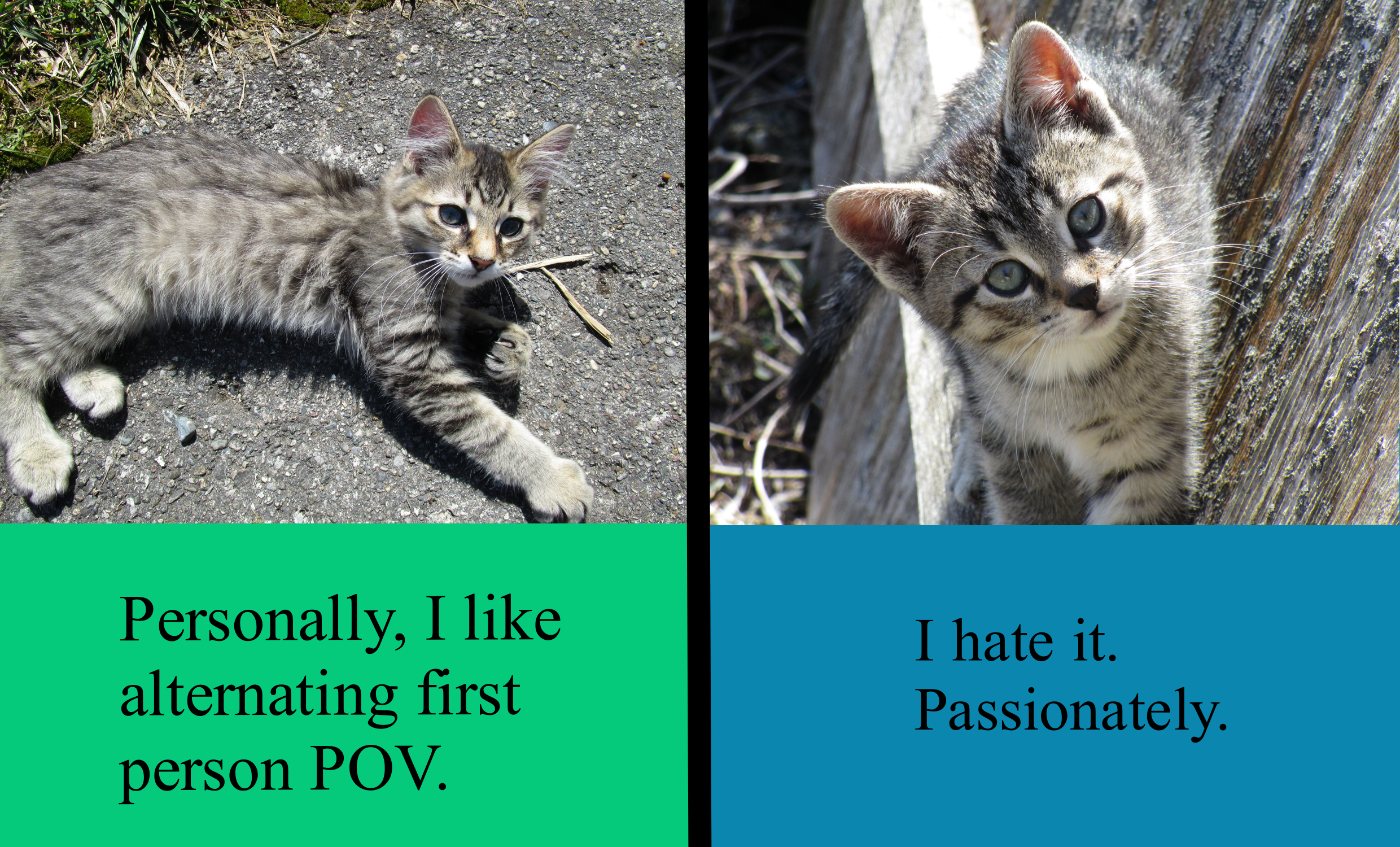
Alternating First Person POV: Like It or Hate It?

As writers, we’re always looking for the perfect POV that will really bring our books and stories to life. For my own novels, I tend to use either third person limited (this is what I think most readers are comfortable with) or first person. I’ve also dabbled with alternating third person perspectives, which I think worked well in my Mentalist fic, Red Brick Road.

Recently, I’ve read a couple of books that used something I’ve never tried before: alternating first person perspectives. The books each focused on two main characters, a male and a female. The POV shifted from one to the other every time a new chapter started. In each case, the POV character’s name was printed on the first page of the chapter, e.g.:

Chapter One: Bobby
Chapter Two: Lisa
Chapter Three: Bobby

This was done – I assume – to prevent readers from becoming confused. I’ll be honest, though – despite this extra effort to be clear, I still frequently forgot which character’s POV I was in. It happened often enough that it got annoying. I would either have to flip back to the first page of the chapter to check the name, or else wait until an obvious clue popped up. If the POV character started talking about Lisa, then I’d know I was reading Bobby’s perspective. If the character adjusted her bra strap, then I’d know it was Lisa (that, or we just learned something really interesting about Bobby).

One of the books I’m referring to here is Allegiant, the third installment of the Divergent series. In perusing the reviews on Goodreads, I found another reader who mentioned the same issue of losing track of which POV was which. The reviewer stated that Tris and Tobias’ voices were not distinctive enough to immediately tell the difference between them.

As soon as I read this, I thought, Yes! That’s exactly it!

In identifying the problem with Allegiant’s alternating perspectives, I think this reviewer also helped provide a possible solution to any writer brave enough to attempt this feat:

Make those POVs different. Make each character’s voice so friggin’ distinctive that you can randomly select any sentence from any chapter, and instantly know whose perspective it is – without having to cheat and look at the first page of the chapter.

I think this would be extremely hard to pull off successfully, but I believe it could be done. That said, anyone considering writing a novel in alternating first person POV should know the potential pitfalls. Even a brief moment of confusion or disorientation takes the reader out of the story, which is a bad thing (especially if it happens over and over again). And just putting the character’s name on the first page of the chapter simply isn’t enough, so really think about whether this POV is the best choice.

Of course, if your heart is absolutely set on alternating first person POV, then there’s nothing I can say to change your mind (we writers can be so stubborn when it comes to our babies). But if you’re still on the fence, consider some other options that might be more effective and easier to execute:

  • My writing partner is just finishing up a novel that alternates POV between the main character (first person POV) and her love interest (third person). It is easy to tell the difference between the two perspectives, and allows the reader to feel deeply bonded to the main character while still exploring the thoughts and emotions of her past (and future) boyfriend.

  • If you desperately want to do two first person POVs, consider writing the first half of the book from Character One’s perspective, and the second half from Character Two’s perspective. I think this would allow readers time to settle in to each POV without being jolted or confused by constant switching back and forth.

  • Alternating third person POV is super fun to write; it lets you explore the thoughts, experiences, and voices of multiple characters. And since you are frequently mentioning the character by name and pronoun, your readers will not have a chance to forget which perspective they are immersed in.

When in doubt, read as many books and stories as you can. Soon enough, you’ll see for yourself what works and what doesn’t, and you’ll know exactly what to do when crafting your own piece of literary art.

Happy Writing! 🙂

Get Writing in 2020!

Why aren’t you writing? *sniffle*

Way back in December 2018, we took a look at perfectionism and how that might be crippling your writing and keeping you from reaching your goals. But that’s only one of many possible roadblocks that could be standing in the way of you finishing (or even starting!) your novel. Whatever your personal hangups are, trust me, you are not alone. There are probably thousands of other authors out there struggling with the exact same issues. I myself have been there more times than I care to recall. But no matter what the hurdle was – chaotic life circumstances, lack of time, a dry spell where the ideas just wouldn’t come – I always made it through to the other side, and you can, too!

In the spirit of making this the BEST WRITING YEAR EVER, I’ve compiled a short list of tried-and-true tips to help you find (or rediscover) your writing groove in 2020:


1.) Give Yourself a Gold Star (You earned it!)

I know this sounds silly and a bit juvenile, but in the past six months I’ve taken to putting a sticker on the calendar each time I get some writing done on a given day. Not only does this act give me a tangible reward each time I write, but it also helps me identify trends in my writing schedule that I would never have noticed otherwise. When I see that I’ve only written three days or less in the last week, I know I’m shoving writing to the side too often, and need to prioritize it more. On the flip side of that coin, nothing beats the feeling of looking back on a week with five or six stickers and knowing that I’m really getting the work done. (I haven’t managed a seven-sticker week yet, but it’s always something to strive for!)


Super-cute picture of my writing group! Photo courtesy of SK Mabry.


2.) Find a Writing Buddy (or Several!)

Just like with exercise routines or attempts to quit smoking, you greatly increase your chances of sticking to a writing schedule if you don’t have to write alone. Your writing partner could be someone you exchange chapters with online as a means of keeping on track, or someone you meet up with in person at Tim Hortons for a weekly writing session. Some great places to find writing partners: online CP match-ups, writing-related message boards, workshops, local writing groups. Don’t have a local writing group? Not a problem. Writers are solitary creatures by nature, but it’s easy enough to lure us out of our caves with the promise of food and being around others who share the same intense passion. Use your local library to put out a call for anyone interested in starting a writing group, and you may be surprised by how many people you connect with, and how invaluable those relationships become. To paraphrase the ghostly voice in Field of Dreams, “If you build it, they will come.”


What big eyes you have…to read more books with!

3.) R-E-A-D

The follow-up to the classic advice “Write every day” is, of course, “Read every day.” I know this sounds counter-productive, and it may have some of you rolling your eyes and thinking, Read every day? Are you serious? I can barely scrape enough time together to write a few measly words a week, and now you want to add more reading to my to-do list? Ugh! My short answer to your rather long-winded complaint: Yes. You should read more. Reading not only sharpens your skills as an author and editor, but it can actually make you write more because it’s sending constant sparks of inspiration down those writerly neurons. I’m never more excited to get clattering on that keyboard than when I’m reading something awesome!


This little bugger tries to stop me from writing – but I don’t let him!


4.) Be a Problem-Solver

You’re not writing. You want to be writing. So, what’s stopping you? Being able to identify your own personal writing roadblocks and find solutions to getting over those humps is key. My CP, Anna, has trouble writing at her house because there are too many distractions like laundry, cleaning, etc. Her solution: she takes her laptop to a coffee shop. I sometimes have difficulty writing because my cat, Del, is jealous of my computer (if you have a cat or dog, you know exactly what I’m talking about). He sits underneath the table where I’m trying to work and cries (loudly) for attention. My solution: I take my laptop to the living room and sit on the couch, where he can happily curl up beside me while I write. If you check your email too much instead of writing, consider working on an older machine not capable of going online (yeah, these devices still exist – my laptop, which proudly features Windows Millennium Edition, can attest to this) or even try writing in a notebook instead of on a computer. My point is, if you can figure out what’s holding you back, you can overcome it.


Self-forgiveness. So incredibly hard. So incredibly worth it.


5.) Forgive Yourself

This may be the most important tip of the bunch, and quite possibly the hardest to pull off. We all have bad writing days, weeks, even years. We all have times in our lives when there’s too much personal drama going on, or our work schedule is crazy, or we just plain can’t find the motivation to get words on the page. This is just part of being a writer. Frankly, it’s just part of life. If you beat yourself up every time you don’t write (or every time you try to write but all the words that come out seem to suck), then you are forgetting something very important: that was yesterday. Today is a new day, a fresh start, a clean slate. Forgive and forget any perceived failures. Wash away lingering doubts and let them swirl down the drain at your feet. Today will be better. Today, you will write.

Happy 2020, everybody! Get writing! (I know you can do it!)

~Gretchen


Author Interview: Elaine Bassier, YA Fantasy

Hey all! Recently I was lucky enough to do an interview with my cousin Elaine Bassier, who happens to be a crazy-talented YA Fantasy author. We talked about everything from resources for self-published authors to unicorn mating habits! For loads of writing tips, helpful websites, answers to burning fan questions, and some very tantalizing hints about the two remaining books in her trilogy, please keep reading!


ATHF: Hi, Elaine! Thanks so much for taking the time to do this interview! Before we get started, please tell everyone a little bit about yourself and your books!

Elaine Bassier: I’m the youngest of five siblings. I was born and raised in Elko, Nevada, and I’m going to go ahead and answer the two most frequent follow-up questions I get when people hear that. 1) No, it’s not near Las Vegas (Elko is in the northeastern part of the state) and 2) Yes, it does snow there. I now live in Spokane, Washington. 1) No, it’s not near Seattle (it’s in the eastern part of the state) and 2) No, it’s not always rainy here.

I’m left-handed (and, fun fact, so is Arianna!). I’m an introvert. I love animals. I have a Golden Retriever named Ruby. I’ve never owned a horse, but I took riding lessons on and off growing up and it’s a dream of mine to one day have a few.

I like to write Young Adult fantasy. My debut novel, Knight’s Duty, is the first book in the Unicorn Knight trilogy. It tells the story of a young woman named Arianna, who longs to be a Unicorn Knight. When she comes across a unicorn who lost her knight and learns she has strange magical powers, Arianna and the unicorn agree to partner together. Under the tutelage of her knight-master Flynn, Arianna’s training as a warrior and magic user begin.

ATHF: I read on Goodreads that you started writing The Unicorn Knight trilogy when you were just 12 years old! That’s so amazing, that the story has been with you since childhood. Are there any details that have remained the same from first concept all the way through to the finished product?

EB: This is a great question! I sadly lost the very first draft of the story when our family computer crashed, so I don’t remember a lot of details about it. I so wish I could look at it again! It’s changed quite a bit since I first started.

The one thing that has remained more or less constant since the beginning, though, is the characters. Arianna has always been the protagonist and she’s always looked the same. She’s always been partnered with a unicorn (though initially it was a male unicorn that became Ronan in later drafts instead of the female Serissa). Most of the other characters have kept their names and personalities, too.

ATHF: Is there anything that totally changed from the way you originally imagined it?

EB: The biggest change I remember from the first draft to the published edition is that Arianna was originally a princess trying to reclaim her throne. Obviously, the plot has changed a ton since that initial idea.

The magic system changed pretty drastically from draft to draft as well. It started with humans having the “traditional” fantasy magic. Then it slowly evolved into the concept of the Magickers, where only magical creatures and a few humans have special powers.

ATHF: I really love how you handled the world-building in Knight’s Duty. You wove the details of setting and culture seamlessly throughout the story, rather than telling it all in a big info dump. Do you have any world-building advice for aspiring fantasy authors?

EB: Thank you so much! That’s so kind of you to say. World-building can be a challenge, especially in fantasy books, because most of the time you are literally creating the entire universe your characters inhabit.

I’m lucky because I love learning about mythology and studying other religions, especially ones with a pantheon of gods. One thing I’d recommend to other writers is to really think about the organization of the world. What form of government does the country have? What is the most popular religion?

My world and the country of Failyn really came together once I developed the idea of the Magickers. Each country has more of one [type of] Magicker than the rest, which then influences a lot of the culture of the area.

Figuring out all of this stuff means you’ll know a lot of details that may or may not end up in your books, but that’s okay. The more you know about your world, the more realistic it becomes in your own mind. That familiarity will come across in your writing, even if you’re not sharing specific details.

ATHF: That is great advice! Do you have any tips for writers in general, regardless of what genre they’re working in?

EB: There’s the obvious one (and one I need to follow myself at the moment!): Write! Whatever you’re writing, just keep going!

I also really like the advice from an author I’ll paraphrase here: Write what YOU want to write. For a very long time, you’re going to be the only one reading your work, so make sure you love it. And don’t think your story is too niche – someone out there, probably several someones, is waiting to discover a book just like yours.

ATHF: In the acknowledgements of Knight’s Duty, you mentioned your friends on Wattpad. For those who don’t know, can you tell us about Wattpad? What exactly is it, and how did it impact your journey to publication?

EB: Wattpad is a website where people can post any kind of writing for other people to view for free. Fanfiction is very popular there, but there is also original fiction and even non-fiction and poetry. The quality of the writing and the grammar can vary wildly, but everyone can find something they like.

With that being said, Wattpad is very popular among teens, which is why I chose to first post Knight’s Duty on it. I wanted to build an audience with people in my target demographic.

One particularly awesome feature on Wattpad is the ability to interact with your readers. People can comment on a single line from the text and you can reply. I loved reading people’s reactions to exciting moments in the book and having discussions with them about where they think the story is going.

I will admit that I think Wattpad works better for people who write fanfiction, or post earlier drafts and even things they don’t ever plan on publishing. However, I’ve made a few good friends there who were the first fans of my work outside of my family and that means a lot to me.

ATHF: I think your book cover is beautiful! The silver and blue tones make me think of the unicorns’ coats. Please tell us a little bit about your cover. Who is the artist and how did you find her/him? Did you already have an image in mind for your cover before approaching the artist? What did it feel like, seeing your finished cover for the first time?

EB: Thank you so much! I love all three of the covers I have for the Unicorn Knight trilogy, but the first is my favorite. My cover artist is R.L. Sather, and I found her on an awesome website called SelfPubBookCovers.com. It has hundreds of covers, each one is unique, and once you buy one, the website won’t sell it to anyone else. It also lets you customize the font and title.

I wasn’t really sure what I wanted the cover to look like when I first started trying to find one. I looked at similar book covers to get an idea of what’s popular in the genre. I highly recommend other authors do the same, by the way: we might say not to judge a book by its cover, but the biggest deciding factor in whether someone will consider reading your book or not is the cover. You want to make sure you’re attracting the right readers.

Looking through the options on SelfPubBookCovers.com, I found what would eventually become the covers for Book 2 and Book 3. However, I couldn’t find a third cover that fit with the other two. I wanted all three to have a similar look so people would know they were part of the same series. So, I contacted the artist who did the other two covers and commissioned a custom piece, which ended up becoming Book 1’s cover. The entire process was a whole lot of fun, and it ended up being the push I needed to actually start the publishing process.

Seeing my cover at every stage – when I first bought it and looked at the finished product, when it was posted online on various websites, and especially seeing the paperback version – was incredible. It made the whole process feel real to me and it was so cool to see something that I had created that looked like an actual book.

ATHF: Sounds like an amazing ending to an incredible journey! Going back to the beginning of that journey, do you have a favorite author, and/or someone who really influenced your writing?

EB: One of my favorite authors is Tamora Pierce. I think anyone who has read her earlier work and my own book will see how she has influenced me. She’s also a Young Adult fantasy author and she’s known for creating strong female characters. If you haven’t read any of her books, I recommend starting with Alanna: The First Adventure.

ATHF: Are there any books, websites, or other resources you’d recommend for authors thinking of self-publishing?

EB: Other than SelfPubBookCovers.com, which I mentioned above, I also encourage aspiring self-publishers to check out Amazon’s Kindle Direct Publishing, or KDP. You’re most likely going to publish on Amazon (and maybe other places) once you do publish, and that website has a bunch of resources, including a community where you can talk with other authors.

ATHF: Now that you’ve survived the process of publishing your first book, what is the most important thing you learned from the experience? Is there anything you’ll do differently the second time around?

EB: I wish I had decided to publish sooner! Seriously, I held off on putting my work out in the world for a long time because I was so afraid of what people might think of it and of me. It was a huge hurdle to get over, but once I did, I was astounded by the support I received from everyone, including people I hadn’t had contact with in years. It’s been a dream come true!

ATHF: I’m so glad to hear that :)! Getting back to Knight’s Duty, I will admit to being a hopeless romantic, so of course I noticed a spark of something brewing between Arianna and Flynn. I’m not asking for a definite answer to “will they or won’t they?”, but is there at least a chance of romance between these two in the next installment? Or maybe Book 3?

EB: I’ll keep this one brief because I don’t want to give anything away, but I think readers will be pleased with what happens between Arianna and Flynn in the future. 😉

ATHF: Any possibility for *unicorn* romance on the horizon? Are they romantic creatures, or are they more practical about that sort of thing?

EB: This is a really interesting question and I’m not sure anyone has ever asked me about it before. I don’t want to go into detail for fear of having written myself into a corner later on, but I will say that unicorns don’t magically appear fully formed. They are mammals and have young in the same way normal mammals would. I don’t have any plans to include a romance between unicorns in the trilogy, but I could definitely see myself writing a short story or something in the future about it to explain everything now that you’ve brought it up!

ATHF: LOL! Speaking of creatures, the alphyns were my favorite ones in Knight’s Duty. Were these an original creation of yours, or did they come from somewhere in mythology? Will they appear in Book 2?

EB: Thanks so much! I loved coming up with the magical creatures and what kind of powers they have. It was one of my favorite parts of writing this story.

The alphyns are not an original creation, although my interpretation of them adds some uniqueness. For example, the alphyns in lore are not associated with concealing or tracking magic like the ones in my book are.

I knew early on that I wanted a wolf-like magical creature because I love wolves/dogs. I stumbled across the alphyn while looking up mythical creatures online (I can’t seem to find the website where I first read about them now), and decided I liked the name. It’s actually a Germanic word that means “wolf.”

I think there are fewer mentions of alphyns in book two than there were in the first book, unfortunately, but you will get more of them in the third one!

ATHF: Awesome! When can we expect Book 2, btw? Is there a release date scheduled?

EB: Yes! I’m planning on publishing Knight’s Honor on May 1, 2019! I’m hoping to do something a little different this time and have both the ebook and the paperback available on the same day. (With Knight’s Duty, I published the ebook first and then the paperback about a month later.)

For those of you who just can’t wait or who might like a preview, the first several (unpolished) chapters are on Wattpad. There will be some changes to the Wattpad version compared to the one that’s actually published, but the overall plot will remain the same.

ATHF: Any tantalizing Book 2 tidbits you can tease us with (don’t give TOO much away!)?

EB: Knight’s Honor has always been my favorite book in the trilogy for several reasons. The action amps up and the characters and their relationships deepen. Plus, you finally get to meet the main villain of the trilogy, and he is both frightening and fascinating. I can’t wait to hear what readers will think of the second book!

ATHF: It sounds amazing. I can’t wait to read it! But since I can’t get the book just yet, and since we’re still doing an interview, is there a question I didn’t ask that you wish I had? If so, what is it and how would you answer?

EB: This might fit in the question about websites you asked above, but I’d like to talk about naming characters, since it’s a fun thing to work on especially with fantasy writing. Many authors say they use baby name books to come up with names for their characters, and I’m no exception. I actually use a website called babynames.com to find names. It even has a handy “tips for writers” section that has my personal favorite advice when it comes to naming fantasy characters.

You probably want something that sounds unique and otherworldly for character names (not many fantasy stories have protagonists named Bob, after all), but I also encourage you to make sure your names are easy to pronounce. If a reader is stumbling over how to say a character’s name every time they come across it, it can create a frustrating experience.

ATHF: ROFL! That’s fantastic advice. (Also, I now have the urge to write an epic fantasy about someone named Bob Smith! ;)) On a slightly more serious note, I just want to say thank you again, Elaine, for taking the time to do this interview, and for sharing your writing gift with the world! We will all be looking forward to reading Knight’s Honor in just a few short days!

EB: Thank you so much!
Using Parentheses in Fiction Writing


BlogParenthesesComic

So, I was reading this book a while back. It was a pretty awesome book, too: great characters, intriguing plot, marvelous descriptions, skillful world-building. Everything was moving along as smooth as can be, and then – WHAM! Out of nowhere, I hit this one paragraph that completely threw me out of the story.

Fortunately, after taking a moment to shake off the jarring experience, I was able to plunge back in and enjoy the remainder of the book. The writer in me, however, couldn’t help but try to analyze what it was about this particular passage that so violently – if temporarily – derailed an otherwise highly entertaining story.

The answer: the entire paragraph was encapsulated in parentheses.

A few years ago, I read a review on Every Day Fiction that really stuck with me. I truly wish I could remember who posted it, so I could give proper credit, but the review went something like this: “Whenever I see parentheses in fiction, it’s like the author is stepping out of the story to address the readers directly.” The truth of this statement hit me so hard, I immediately went through my own novel and started taking out the parentheses wherever I found them.

Ever since I read that review, that’s all I can think of when I come upon parentheses in fiction writing – it’s like the writer wanted to convey certain information, but couldn’t come up with any other way to tell the readers than whispering it right in their ears. In that instant, the voice changes from “narrator” to “author” and it really does take you out of the story, if only for a moment or two. The only exception I can think of is the case of first-person stories.

If you’re writing in the first person, then your POV character is already directly addressing the audience. So, it might feel natural, depending on the character’s personality and speaking style, for him/her to take the reader aside and whisper something in confidence. It might even be humorous:

“Paul actually flirted with me today. (Yes, that’s the same guy who took Katie to prom and then dumped her the next day via text message. And no, I most certainly did not flirt back.)”

But in most cases, parentheses are something to avoid when it comes to writing fiction. They change the voice, break the flow, and jar the reader.

So, now some of you are panicking, right? Because your fiction story does have parentheses, and you don’t know what to do about it.

It’s okay – just relax and take a deep breath. Unlike some issues, this one’s very easy to fix.

The first thing you need to do is determine whether the information inside the parentheses is even truly necessary to the story. (A lot of times, it isn’t.)

Ex:

“Billy leapt from the car and raced into the parking lot to greet his fellow Boy Scouts with high fives and fart jokes. The troop leader (Scott) and his two assistants (Maurice and Isaac) stood off to the side, smiling at the boys’ antics.”

Well, maybe Scott, Maurice and Isaac aren’t very important to the story. Heck, maybe this is their only appearance in the whole book. If so, do we really need to know their names? Why not just cut that info out entirely and change it to:

“Billy leapt from the car and raced into the parking lot to greet his fellow Boy Scouts with high fives and fart jokes. The troop leader and his two assistants stood off to the side, smiling at the boys’ antics.”

Reads a bit smoother, doesn’t it?

But, on the other hand, maybe those three dudes are important in your book. Maybe this is the first of many appearances by the trio. In that case, try simply off-setting the information with commas, rather than using the parentheses:

“Billy leapt from the car and raced into the parking lot to greet his fellow Boy Scouts with high fives and fart jokes. The troop leader, Scott, and his two assistants, Maurice and Isaac, stood off to the side, smiling at the boys’ antics.”

It’s still a bit awkward, but less so than when the parentheses were in there.

Em dashes are also good ways to set certain information apart without completely breaking the flow the way parentheses do. In many cases, em dashes and parentheses are interchangeable:

Instead of:

“Jake flopped onto the couch, crossing his feet (which smelled like decomposing skunks) right next to Maria’s head. She quickly fled, wrinkling her nose and fanning the air.”

Try:

“Jake flopped onto the couch, crossing his feet–which smelled like decomposing skunks–right next to Maria’s head. She quickly fled, wrinkling her nose and fanning the air.”

By working with the scene a little more, you could probably do an even better job of integrating the information:

“Jake flopped onto the couch, crossing his feet right next to Maria’s head. A stench like decomposing skunks instantly enveloped her. Maria squealed and fled, vigorously fanning the air.

‘Dude,’ she choked, ‘invest in some Odor Eaters.'”

So, when you come across parentheses in your fiction, and you feel like they just aren’t working, don’t panic – you can easily replace those curvy symbols with commas or em dashes, do a little paragraph restructuring, or even eliminate the text inside the parentheses entirely. All are acceptable solutions – it just comes down to taste and personal writing style. However you choose to deal with those pesky parentheses, the goal is always the same: a smooth reading experience for your audience.

Battling Back the Beast: How to Tame Your Overlength Novel

HarryPBigSpider2


If you’re like me, you feel a naïve rush of hope every time you spot a new article about overlength novels. Then, by the end of the article, you feel crushing despair. Because the answer’s always the same: if you’re a first-time novelist, and your novel’s overlength, your chances of landing an agent or publisher are slim-to-none.

Sadly, it makes sense – extra-long books cost more to publish (extra paper, extra ink). They take up more horizontal space, meaning fewer copies can occupy the bookstore shelf, and they can also be intimidating to consumers because giant tomes are both more expensive and more daunting to read. For a publisher to take that kind of risk on an unproven author (J.K. Rowling and Stephen King can go ahead and relax) doesn’t make a whole lot of sense.

The arguments against overlength novels are all very logical. The problem is, if you’re like me, and your novel falls into this category, then you’re pretty much screwed, right? You’ve got a product that is most likely unmarketable to agents and publishers. Sure, you could self-publish, but that doesn’t solve every issue. The length will still be off-putting to readers, and you may have to spend (and therefore charge) more if you’re doing a print edition. Another solution might be to split the novel into two or more parts. This will only work if you’ve genuinely got two or more complete stories contained within your bulky mammoth of a book – which unfortunately isn’t the case for the majority of overlength novels (it wasn’t for mine).

The best option for most writers, even those who want to self-publish, is simply to cut your manuscript down to size. An “acceptable” length for a first-time novel is about 90,000 to 120,000 words, according to Writer’s Market. I’ve heard from other sources that even going above 100,000 words is a risk. For fantasy or science fiction novels, you have a little more breathing room, with the maximum acceptable length being around 150,000 words. (This is to allow for the world-building necessary in these types of books.)

So, if your book is over 200,000 words, and you’re not even at the climax yet, you’re probably feeling pretty darn hopeless right now, because that’s a LOT of material destined for the cutting room floor. I know that feeling of despair all too well, because I’ve been there. My novel’s first draft weighed in at almost 300,000 words. Shocking, I know. Hopefully, most people reading this will get to say, “Well, at least mine’s shorter than hers.” That may be small comfort, however, when reality sinks back in and you’re still looking at 50,000-100,000 words of cuts.

Thankfully, the saga of my overlength novel has a somewhat happy ending: the current draft is in the 150,000-word range, and it’s getting closer to “acceptable” length every day. To me, it’s nothing short of a miracle. A time-consuming, frustrating, and frequently heartbreaking miracle, but a miracle nonetheless.

So, to all of my fellow overlength novelists out there, I came here today to give you back your hope. I came here to tell you it CAN be done: your novel CAN be whittled down into something that would not make an agent physically cringe at the mere sight of your word count. And I came here, most importantly, to tell you HOW this can be accomplished.

The following are some strategies I used to cut more than 140,000 words from my first novel, shaping it into a sleeker, stronger and hopefully more marketable book:

LARGE-SCALE CUTS

Go chapter by chapter. Do a breakdown of the vital information each chapter contains (e.g. maybe Chapter Two introduces an important character, or advances the plot in some way). Identify chapters that don’t accomplish very much. Cut those chapters entirely, and find other places to fit in the few stray passages that were relevant to the overall story.

Go plotline by plotline. If your book’s upwards of 200,000 words, chances are you’ve got not just a main plot, but quite a few subplots and other threads woven in there (e.g. the SPEW storyline in Harry Potter and the Goblet of Fire). Choose which are the most important to the larger arc of the book. Cut out the rest. And remember to eliminate all traces and future mentions of scenes you’ve decided to delete. If you’re not careful, you’ll wind up having the main character referring back to some incident that’s no longer in the book. Cue reader confusion!

Learn to make hard choices. You will have to cut chapters you adore. You will have to eliminate characters you have grown to love, characters who feel like real people. You will have to bring the axe down on some of your most breathtaking descriptions, your funniest jokes, and the scene it took you two months to get perfect. Take a deep breath, wipe a tear from your eye, and DO IT. As Stephen King says, “Kill your darlings.”

SMALL-SCALE CUTS

Go paragraph by paragraph. Weed out anything that wanders, meanders or breaks the flow. Cut out any bits that go off on boring tangents that take the reader away from what the scene is trying to accomplish (e.g. backstory is cool, but if you suddenly zip back to a main character’s childhood for three paragraphs right when he’s in the middle of a conversation, the readers are going to lose their place in the conversation). Also be on the lookout for redundant sentences (e.g. “Greg had hoped to find Mandy somewhere in the building, but he was out of luck. He looked upstairs and downstairs and couldn’t find her anywhere.” I mean, do you really need both of those? They kinda say the same thing. Plus, the first sentence gives away exactly what’s going to be revealed in the second. One of these babies needs to go!)

Change passive to active. Zero in on any instances of passive voice and rearrange those parts into active voice (e.g. change “The tests were handed out by Julia” to “Julia handed out the tests”). This usually cuts a word or two, not to mention the fact that most publishers hate passive voice, so it’s like a “two birds, one stone” kind of deal. 🙂

Go line by line. Check for unnecessary words in each sentence. Like, maybe you have Billy tilting his head back to look up at the sky. Well, if Billy’s looking at the sky, do you really need to say that he’s tilting back his head or do you even really need the word “up?” The mere act of looking at the sky implies his head is tilted back and he’s looking in an upward direction. (Unless Billy’s in an alternate universe where up is down and down is up. Then some clarification would be warranted.)

Learn when to tell instead of show. I know, I know, one of the Golden Rules of Writing is “Show, DON’T Tell,” but you have to know how to apply that rule. A story that tells absolutely everything isn’t going to be very good. But neither is a story that shows absolutely everything. When I was writing my first draft, I took the “Show, Don’t Tell” Rule a bit too seriously, and wound up with long paragraphs describing my character unzipping his backpack, searching around inside it, pulling out his notebook, unzipping a different compartment on his backpack, searching around inside it, pulling out a pen, and then, FINALLY beginning to write in his notebook (after he’d rezipped all the compartments, of course). See what I mean? There are things you must show because they’re vital to plot, character development, etc. Backpack zipping and other mundane tasks like walking and normal breathing are not things that need to be shown in depth. Just do a quick “tell” for those types of things, and you’ll be better off.

MORE TIPS AND TRICKS

Don’t do it alone. Get as much help as you can from friends, relatives, writing group members, English teachers and anyone else you can convince to read your book. Emphasize to these helpers that you need to cut words, and you need their honest opinions about what’s boring, what’s unnecessary, and what just plain doesn’t work.

Set small, reachable goals. Baby steps will get you to the finish line. My initial goal was to cut 100,000 words from my manuscript. However, that was too overwhelming to face all at once, so I broke it down into smaller chunks. I wrote the number “100” on a piece of blank white paper. When I’d successfully cut 1,000 words, I crossed out the “100” and wrote “99.” I chugged steadily along, cutting 1,000 words at a time, and then rewarding myself by getting to cross out the current number and write a lower one. Finally, one amazingly joyful day, I got to write “0.”

Once I’d completed the massive 100,000-word cut, I set a new goal: 10,000 more. This time around, instead of measuring by the thousands, I decided to cut 100 words from every chapter. Since my novel has just shy of 100 chapters, 100 words from each would result in a 10,000 word cut. It worked!

Cut anything that’s not awesome. You want your whole book to rock, right? Well if there’s a paragraph that doesn’t “wow” you, why not just get rid of it? Do the same for chapters, dialogue, plotlines, etc. Make the entire novel sparkle by slicing away any parts that don’t shine quite brightly enough.

And finally:

Remember what you’re fighting for. Sure, you want to get published, and to have a marketable product that people will want to read. But honestly, deep down, that’s not the main reason you’re doing this. Try to remember, through all of the cuts and the long hours and the heartbreak, that what you’re really fighting for is a better book. The very best book you are capable of writing. A book you would be proud to send to an agent, hand to an editor, or simply put out into the world with your name on the cover in nice, bold print.

And however much of your novel you need to cut in order to achieve this, you will get there.

One word at a time.

HarryP Little Spider