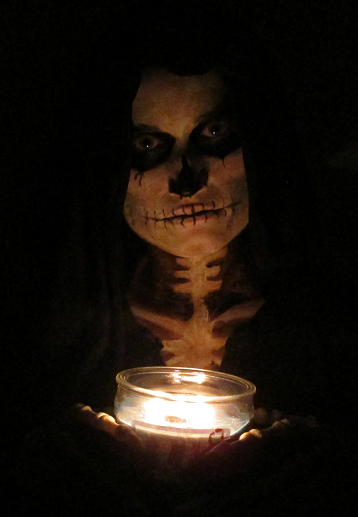
Growing up, I got to know my brother’s bedroom floor pretty well. I knew all the scratches on his black-painted wooden bedposts, the rectangular shapes made by the interconnected wires holding up his mattress, the worn-out softness of his bedraggled carpet. And no, this isn’t because he pinned me to the floor and made me beg for mercy (that was reserved for when he tied me to the swingset).
I knew my brother’s bedroom floor because I slept there every time he told me a scary story. That was the rule: you scare your sister, you get to deal with her nightmares. Truth be told, I didn’t usually have nightmares after one of his stories (probably because I was too terrified to close my eyes in the first place).
Don’t get me wrong – I was a very willing audience. I BEGGED him to scare me. I especially loved it when he read to me from a particular series of books, the first of which was entitled Scary Stories To Tell In The Dark by Alvin Schwartz.
These books were FANTASTIC. (They actually just came out with a documentary about this series, as well as a feature film based on the first book!)
Back in the day, though, the books were just, well, books. But they were also SO much more. My elementary school friends and I passed around the Scary Stories trilogy like candy. The books terrified us, delighted us, and – most importantly – made us want to read. We had no idea at the time that parents all over the country were complaining about the series, or that the Scary Stories books were actually banned in some places!
Each book featured a collection of short stories that consisted primarily of urban legends from around the world. Some of them you would recognize as classic campfire tales: “The hook,” “High beams,” “The wendigo,” etc. (Basically the first season of Supernatural in the form of a children’s book, LOL.) Some were more obscure. Some weren’t even stories, just creepy vignettes with no real plot (“The thing” comes to mind here). Some were just about leaving a disturbing image imprinted on the reader’s brain…and boy, did they ever!
The entire series had these wonderfully gruesome, dripping-with-gore illustrations by Stephen Gammell that were as much a part of the appeal as the stories themselves. In one recent reprint, Gammell’s illustrations were actually removed and replaced, presumably for being “too intense” for young audiences. The trilogy has since been re-released with the original illustrations (thankfully) restored.
I can’t imagine a Scary Stories book without them!
Nor can I imagine my childhood without those terrifying tales. But as much as I loved reading them (or, even better, having someone else read them to me in full dramatic fashion), I often regretted the decision later, when the house was dark and quiet and all the little floorboard creaks and weirdly-shaped shadows that weren’t noticeable in the daytime suddenly came to life.
Thus, my childhood was a marvelous, ever-repeating cycle of hunger for scary stories followed by intense buyer’s remorse at having read them.

For better or worse though, those dark, eerie, disturbing tales I shared with my friends as a kid shaped the person I grew up to be. To this day, I still have a special place in my heart for all things spooky and creepy…and I wouldn’t have it any other way. Supernatural, The X-Files, and Grimm are long-time favorite shows of mine. On my calendar, Halloween is circled because it’s one of the most exciting days of the year. And my first-ever published story, a flash fic entitled “Grisly,” is – you guessed it – a horror story.
And now, as the leaves begin to change, and the nights grow longer, I have a new horror story coming out – one that takes me right back to my childhood, and my love-hate-love relationship with those deliciously evil scary stories.
“The Haunted Fleshies” is available now in the September 2019 Issue of The Society of Misfit Stories Presents… and I could not be more thrilled:

https://www.smashwords.com/books/view/956628
The story follows Grace, a little girl much like the one I used to be (and sometimes still am), who can’t get enough of her older brother’s favorite books (even though they scare the pants off her). After a terrifying nighttime encounter in her own backyard, Grace is convinced that the monsters in the books are real, and they’re coming for her. Whether or not she’s right, one thing is for certain: someone – or something – in the neighborhood has a taste for blood.
My hope is that this story will take you back to when you were a kid, sitting around a crackling campfire, swapping tales of hook men and golden arms, and laughing at how silly they are. But then, every so often, you’ll hear a branch snap or some leaves rustle and you’ll glance into the dark woods beyond your fire’s little circle of light, and wonder if maybe, just maybe, something could really be lurking out there.
Happy reading! 😉
~Gretchen
Coming up on ATHF: Book reviews for Knight’s Honor and Plain Dane: Dawn of Power, plus a review of Lucifer Season 4 on Netflix!
 as the HERO flies...