What do you do when you’ve written a contemporary novel, but then it takes you 15 years before you’re ready to publish it? Do you update the manuscript for current events, technology, etc.? Leave it as-is, despite the fact that it’s now dated? Make everything as vague as possible and hope no one notices when exactly it’s supposed to be set?
This is the issue I faced with my first novel, Even Heroes. Although the initial draft was completed around 2007, the editing took place in spurts over more than a decade. All throughout the process, I flip-flopped between updating the time period and keeping it the way I originally had it.
At various points during revisions, my main character was listening to music on either a Walkman, a Discman, an mp3 player, or a smartphone. Social media platforms changed as they went in and out of style, seemingly with the direction of the wind. Current events were mentioned, taken out, then added back in again.
As I came close to a blessed final draft, the setting dilemma got settled once and for all, much to my relief.
Here’s where I landed:
The original 2004-2005 time period stayed put, however, many of the more dated references to technology were eliminated.
In the end, I hoped for something that would feel almost timeless, like a kid could pick the book up in 5-10 years and understand that it was set in the past, but not be stumbling over outdated references every five minutes.
I decided not to update the setting for several reasons.
1) Technology changes too fast! Even if I made all the references current at the time of publication, it would be outdated within a year or two anyway.
2) Political climate. Parts of my book take place in Detroit, which was going through a really hard era when I was writing the book. Some of the issues the citizens were struggling with back then fit with the story I needed to tell, so it made sense to stick with that very corrupt, dark period in the Big D’s history.
3) Social climate. This is just a purely personal opinion, but I feel like we, as a society, have fundamentally changed in the last 20 years. We are harder, we are meaner, and there is no longer any such thing as “sacred” or “off limits.”
Remember when The Sixth Sense came out back in 1999? There is a twist at the end of that movie, and there seemed to be a conscious effort by most viewers to preserve that secret for others, rather than spoil it. We wanted other people to have that same moment of surprise that we felt.
There was something magic about that–the unified effort to keep a secret, the basic consideration people were showing for their fellow man.
I think that magic is gone now. If The Sixth Sense came out today, people would be vying to be the first to spoil it for as many viewers as they could in the splashiest possible way.
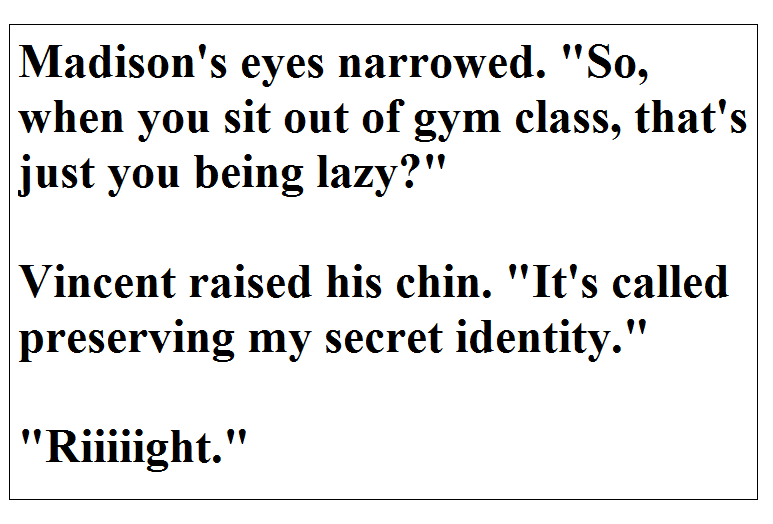
In my book, the main character is a superhero. Despite his precautions, someone could manage to follow him home one night and blab his secret to the whole world. Back in 2004, in that kinder world where “good” secrets were still something precious, someone would be much less likely to do this.
There is one element of my book that I actually wish had become outdated, but sadly it hasn’t come to pass.
I began writing Even Heroes in 2004, a mere 5 years after the tragic events at Columbine High School. My book deals with a similar tragedy, aiming to look at bullying, school shootings, and youth in crisis through the lens of a superhero story–something I didn’t think had been done before.
At the time of writing, I could never have even imagined that school shootings and mass shootings would become so commonplace over the next two decades that many are not even deemed newsworthy.
Four months before my publication date, we had the worst school shooting in our state’s history.
As much as I want my book to be timeless, this is one way that I would absolutely love for it to become a relic of the past. I want kids in ten years to read it and wonder how such a thing could’ve been possible–a phenomenon so heinous, it’s shocking that it was ever allowed to happen.
If we ever get to that point with school shootings in America, where kids are reading about it in history books, rather than living it in the form of practice drills (or worse), I will gladly welcome in that new era.
In the meantime, if my book–even with its slightly dated references–provides hope for even one kid out there who’s struggling, then it has more than fulfilled its intended purpose.
As writers, we’re always looking for the perfect POV that will really bring our books and stories to life. For my own novels, I tend to use either third person limited (this is what I think most readers are comfortable with) or first person. I’ve also dabbled with alternating third person perspectives, which I think worked well in my Mentalist fic, Red Brick Road.
Recently, I’ve read a couple of books that used something I’ve never tried before: alternating first person perspectives. The books each focused on two main characters, a male and a female. The POV shifted from one to the other every time a new chapter started. In each case, the POV character’s name was printed on the first page of the chapter, e.g.:
Chapter One: Bobby Chapter Two: Lisa Chapter Three: Bobby
This was done – I assume – to prevent readers from becoming confused. I’ll be honest, though – despite this extra effort to be clear, I still frequently forgot which character’s POV I was in. It happened often enough that it got annoying. I would either have to flip back to the first page of the chapter to check the name, or else wait until an obvious clue popped up. If the POV character started talking about Lisa, then I’d know I was reading Bobby’s perspective. If the character adjusted her bra strap, then I’d know it was Lisa (that, or we just learned something really interesting about Bobby).
One of the books I’m referring to here is Allegiant, the third installment of the Divergent series. In perusing the reviews on Goodreads, I found another reader who mentioned the same issue of losing track of which POV was which. The reviewer stated that Tris and Tobias’ voices were not distinctive enough to immediately tell the difference between them.
As soon as I read this, I thought, Yes! That’s exactly it!
In identifying the problem with Allegiant’s alternating perspectives, I think this reviewer also helped provide a possible solution to any writer brave enough to attempt this feat:
Make those POVs different. Make each character’s voice so friggin’ distinctive that you can randomly select any sentence from any chapter, and instantly know whose perspective it is – without having to cheat and look at the first page of the chapter.
I think this would be extremely hard to pull off successfully, but I believe it could be done. That said, anyone considering writing a novel in alternating first person POV should know the potential pitfalls. Even a brief moment of confusion or disorientation takes the reader out of the story, which is a bad thing (especially if it happens over and over again). And just putting the character’s name on the first page of the chapter simply isn’t enough, so really think about whether this POV is the best choice.
Of course, if your heart is absolutely set on alternating first person POV, then there’s nothing I can say to change your mind (we writers can be so stubborn when it comes to our babies). But if you’re still on the fence, consider some other options that might be more effective and easier to execute:
My writing partner is just finishing up a novel that alternates POV between the main character (first person POV) and her love interest (third person). It is easy to tell the difference between the two perspectives, and allows the reader to feel deeply bonded to the main character while still exploring the thoughts and emotions of her past (and future) boyfriend.
If you desperately want to do two first person POVs, consider writing the first half of the book from Character One’s perspective, and the second half from Character Two’s perspective. I think this would allow readers time to settle in to each POV without being jolted or confused by constant switching back and forth.
Alternating third person POV is super fun to write; it lets you explore the thoughts, experiences, and voices of multiple characters. And since you are frequently mentioning the character by name and pronoun, your readers will not have a chance to forget which perspective they are immersed in.
When in doubt, read as many books and stories as you can. Soon enough, you’ll see for yourself what works and what doesn’t, and you’ll know exactly what to do when crafting your own piece of literary art.
It’s almost New Year’s Eve, but you’re not waiting for the ball to drop. You’ve already made your resolution: 2019 is the year you’re finally going to write that novel. Yay!
Of course, in all honesty, you’ve made this resolution before, haven’t you? (Come on, just admit it already.) But this time, it’s going to be different, right? No more excuses. No doubt about it. That bad boy is getting written!
Well, good for you! That’s a great goal and I wish you much success in your endeavor. However, before you go prancing into 2019 with big plans and high hopes, perhaps you should take a minute to consider why you haven’t written that future bestseller yet.
Maybe your idea for your novel is so blindingly spectacular that you’re afraid whatever you actually put down on the page will never measure up. Maybe you did start writing, but after three migraine-inducing hours of staring at a blank screen, you only managed to produce two sentences. And they both sucked. Maybe you even sweated and cried and bled your way through an entire chapter…only to chuck the whole thing out later because it wasn’t “good enough.”
If this sounds like you, then you may be a perfectionist…and it just might be crippling your writing.
First things first: if this is you, don’t despair! You can overcome the obstacles perfectionism presents and even learn to use it to your advantage.
The hardest – and most important – thing any perfectionist must do when writing the first draft is to let go. Your first draft will not be perfect. It can’t be. It shouldn’t be. Rage at the heavens, sob uncontrollably, binge-eat chocolate-covered pretzels – do whatever you have to do to help you come to terms with this painful truth.
Give yourself permission to be messy, to color outside the lines, to melt six different crayons together and make a new color. Letting go is terrifying, but it can also be incredibly freeing. Just ask the blond lady on this water bottle:
In case you can’t see it in the picture, the water inside this bottle actually IS frozen. Cute, huh? 🙂
The first draft is the time to lock perfectionism in a cage. I mean, definitely give him some food, a bowl of water, a chew toy, a blankie, etc. – you don’t want to kill him. You just want him to take a nap for a while. He’ll probably whine a bit, but don’t worry – he’ll settle down eventually.
Here are a few practical tips for combating perfectionism in the first draft:
1.) Throw it all out there.
In the photo at the top, the author is having difficulty deciding which verb to use. She’s trying to choose the “perfect” word for the way Miguel moved down the hallway, and she’s stuck on that sentence because she can’t make up her mind.
Wanna know something cool? She doesn’t have to make up her mind! The author can simply write out several options, leave them all in the sentence, and move on to the next one. Then, during a later phase (usually the first round of editing), she can choose which word feels the best…or maybe come up with something else even better!
I do this all the time when I write. Indecision is a progress-killer, so if I can’t decide, I just throw it all out there. You can do it with single words, or with whole sentences and paragraphs. It looks like this:
Miguel walked/strolled/moseyed down the hall, unconcerned about the envious stares following him.
When I go back through to edit, the perfect word will usually jump out from the pack.
2.) Just skip it.
Remember back in high school, when you were taking a math test and didn’t know the answer to problem number five? What did you do? You didn’t spend your entire hour agonizing over that pesky fifth question, leaving the other thirty-five unanswered (at least, I hope you didn’t). No, because if you did that, you’d fail the test. So, you just skipped it, moved on to number six, and then came back to five later, if you had time.
That same strategy can work for writing. If you’ve been working on the same passage for days or even weeks, and just can’t get happy with it, my best advice would be to skip that passage and move on, knowing you can come back and fill it in later (thankfully, writing a book is not a timed test).
I did this with one scene in Scars – the part where Jack tells Lily about the werewolf attack. I just could not get through that scene. Everything I wrote seemed like crap. It was holding up the whole rest of the story. Finally, I just skipped over it and came back at the end. And guess what? It was totally fine. 🙂
The skipped scene DID get written and the story got published in this lovely book. It all worked out! 🙂
Of course, in order to do this, you must have a general idea of what’s going to happen in the scene, because it impacts the rest of the story. E.g. if you’re skipping the chapter where Rosario tells Kevin she has heat vision, then don’t write him as completely shocked/flabbergasted in the next chapter when she melts the tires on the bad guys’ getaway car.
3.) Free Writing
Think about this like a mini NaNoWriMo. Set a timer for five, ten, twenty minutes – whatever fits your schedule – and just write the whole time. Don’t go back and make corrections. Don’t stare at the page thinking about the perfect phrase. Your keyboard should be clacking the entire time. Or, if you’re old school, your pen should be scratching the page continuously. If it’s totally quiet in the room, then you’re not writing.
It may not be pretty, but for extreme cases of perfectionism, this will at least get words on the page. Words that can be rearranged and molded into something beautiful later. If the blank page is your worst enemy, this exercise can help.
Once that brutal first draft is done, you can finally let perfectionism out of his cage for a little while. Let him run amok all over your book, gobbling up those nasty typos, poor word choices, pointless paragraphs that don’t move the story forward, etc. He’ll be thrilled! Just don’t leave him out too long. If he can keep you from writing your book in the first place, he can just as surely keep you from ever submitting or publishing it.
Learn to know the difference between editing something and editing it to death. (If you’re re-reading for the fiftieth time and obsessing over the tiniest phrases which sounded good ten readings ago, you’re probably in “death editing” mode.) Remember how hard it was, in the beginning, to accept that the first draft wouldn’t be flawless?
This part is even harder, because now you have to face the fact that your novel will never, no matter how many times you and your editors go over it, be 100% perfect. Because you’re not perfect. And those tiny little imperfections you’ll never completely erase? They might just be what your readers relate to and fall in love with.
So, when the book is finally the best you (and your crit partners and betas) can make it, it’s time to do that scary-wonderful thing again: let it go.
The year 2019 is coming. You’ve already made the resolution. Now, you have to decide: Do you want to be the person who had a fantastic idea for a novel in 2019? Or do you want to be the person who actually wrote one?
Hey, all! In my previous post I mentioned Author Mentor Match, a mentorship program for aspiring YA and MG authors. Writers hoping to apply for the program are encouraged to create blog posts about themselves and their books, so here’s mine!
I’m so excited to read everyone else’s posts (I’ve already read some, and everybody’s books sound awesome!). Also, a HUGE thank you to all of the Round Three mentees who volunteered their time to give away query critiques to this round’s hopefuls. I was lucky enough to win one from Lucy Hallowell, who gave me lots of wonderful feedback and encouragement. Thank you so much, Lucy!
ABOUT ME
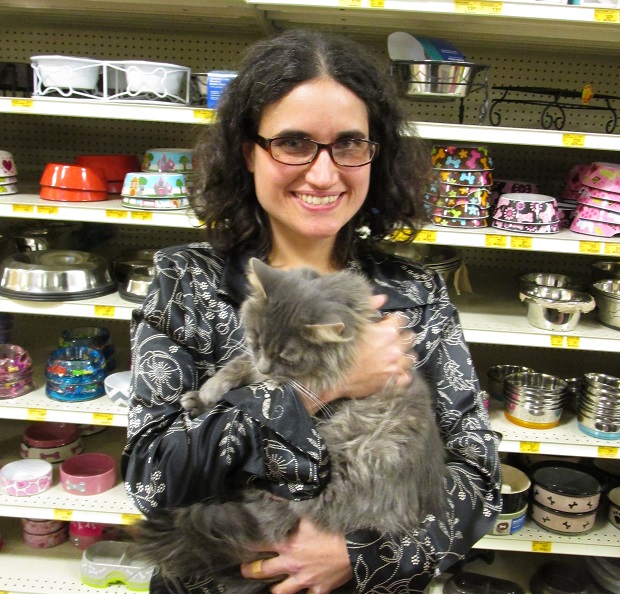
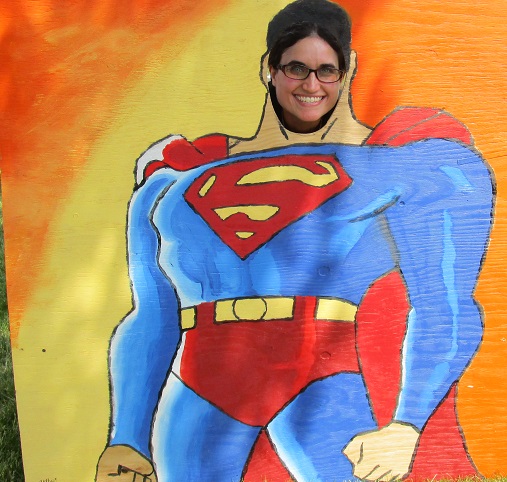
ME! (I am the one with slightly fewer gray hairs.)
I am thirty-seven years old, I have Asperger’s, and I work as a home health aide. I’ve been doing that for over fifteen years and I love it. I’m also passionate about feral cats and I spend a lot of time caring for the strays in my neighborhood. Some of my best friends walk on four legs! (Okay, now my human friends are giving me the skunk eye. I said “some,” not “all”!).
This is Jericho, one of the feral cats I take care of. When he first arrived, he had almost no fur on his body whatsoever–a severe allergy had caused him to pull it all out. Now, thanks to periodic allergy shots, his fur has grown back and he is no longer itchy!
I’ve been writing for about fifteen years, give or take. I write pretty much everything–horror, humor, romance, fantasy, scifi, novels, novellas, novelettes, short stories, scripts, flash fic, fanfic, nonfic, poetry, kidlit. You name it, I’ve probably at least dabbled. I think I write so many different things because I like to read so many different things. To me, a good story is a good story, no matter what the format/setting/genre/age category.
In addition to writing, I also help run my local critique group. The writers I’ve met through this group are a-maz-ing and super-talented! I am so lucky to have them in my life. I smile every time I think about how much we’ve all gained from the honest opinions of our fellow authors. (Yes, even when it hurts. Especially then.)
ABOUT MY BOOK
Working Title: EVEN HEROES
I would best describe it as a real-world superhero story. You know how Batman and Green Arrow and Hawkeye don’t have any superpowers but they go out and do awesome stuff anyway? It’s like that!
When the book starts, my main character, Vincent, is in a pretty dark place. He’s thirteen years old, has acute asthma, and he’s dealing with a severe bullying problem at school. The same kids have been targeting him for years, and he’s too ashamed-and afraid of retaliation-to tell anyone what’s going on.
He definitely can’t tell his mom–she’s already a nervous wreck. She’s so afraid of him having an asthma attack that basically the only physical activity he’s allowed to do at school is walk to class…slowly.
So, Vincent escapes reality the only way he knows how: by diving into his favorite comic books. He loves everything about them–the artwork, the stories, and most of all the way the heroes stand up for people being victimized…people like him.
In the back of his mind, Vincent has always known that if he could do absolutely anything, if he had no restrictions, physical or otherwise, he’d want to be a superhero. Of course, this is the real world, and there aren’t really superheroes flying around. But a person can fantasize, right? No harm in that.
Except lately, Vincent’s fantasies aren’t so harmless. Lately, he’s been having dark, bloody thoughts of taking revenge on the classmates who’ve been hurting him. Lately he’s been feeling like the walls are slowly closing in all around him, inch by inch, and it’s getting harder and harder to escape into the bright-colored superhero adventures of his comic books.
Vincent finally reaches his breaking point after a disastrous visit to the school guidance counselor (note: it’s a bad idea to write on a career survey that you want to be a superhero), followed by the most vicious prank the bullies have ever pulled.
Vincent doesn’t know what to do, but he has to do something or else he’s going to go full-on crazy. So, he decides to reclaim his life by doing the one thing he’s always dreamed of: becoming a superhero. No matter how insane/stupid/impossible it sounds, no matter how dangerous it is, no matter how much strain it puts on his already weak lungs, he is going to do this thing. (Or die trying.)
Basically, this is a story about a kid who’s been caged for thirteen years finally setting himself free, testing his wings, and finding out what he’s really capable of.
RANDOM BITS OF INSPIRATION
-Finding a complete deer skeleton at the bottom of a lake when my brothers and I were kids
-Talking to one of my brothers about how much comic books meant to him growing up
-The very real tunnel system under a school I visited
-A person I once met who thought about doing something very bad–but decided not to
-A psychology class where we learned how to determine whether a child’s asthma was primarily stress-induced or allergy-induced
-My own crazy fangirl obsession with superheroes
-My own experiences being bullied in junior high
WHAT’S COOL ABOUT MY BOOK
-Superhero Fun! Awesome costumes, wardrobe malfunctions, secret identities (and trying to keep them secret), fame and publicity, watching the character juggle his regular, everyday problems with his superhero problems. The most fun parts are of course when those two sides of his life collide unexpectedly. 🙂
-Superhero Drama! Aside from the fun, adventure-y parts of the story, you also get to see the character wrestle with the more heartbreaking aspects of heroism–that he can’t save everyone, that when he screws up people can die, and that some people are past the point of even wanting to be saved. (And in a different life, he might’ve been one of those.)
-He’s NOT the chosen one. Don’t get me wrong–I love, love, love “chosen one” stories. I am totally into Harry Potter, Sword of Truth/Legend of the Seeker, Kevin (Probably) Saves the World, etc, etc. I love destiny and prophecy and special powers and people born half-angel or half-demon or with psychic mermaid blood which makes them the only one who can ignite the sacred torch of immortality. But for this story, I just thought it was cool that there really wasn’t anything special about this kid. Nobody showed up to rescue him from his crappy life and whisked him off to some amazing, magical world. He just had a dream to do something awesome and he did it. No help. No powers. No destiny. Just him.
-Platonic Boy/Girl Friendship That Doesn’t Turn Into Romance (Because Not Everything Has To Go That Way). Think Harry Potter and Hermione Granger, or Severide and Shay on Chicago Fire, or even Mulder and Scully before it got romance-y. Opposite-gender friends who can hold hands without it being awkward. Friends who can tell each other when there’s something on the other person’s face. Friends who would fight in a war zone side by side, ready to lie down and die for each other, but they’re not going to start making out in a moment of passion. Just real, true best friends in every sense of the word.
-The Magic Age of Thirteen. One of the things I love about my character is that he’s right on the borderline between being a little kid who still believes in dreams and an angry teenager who’s about to become destructive. And even though he chooses to embrace the joy of childish dreams, that angry teen is still inside of him, ready to bare its fangs throughout the book.
WHAT KIND OF MENTEE WOULD I BE?
Terrified. Excited. Receptive. Grateful.
All of my first drafts tend to be reeeeally long, so I’m pretty merciless about making cuts and changes to my babies. I have graveyards full of dead darlings…
RIP, Darlings!
…And sometimes, I have nightmares about them coming back to life and eating my brains…
Braaaaaaaainzzzzz!
I think of cutting words like power-spraying all the mud off a vehicle that’s just been off-roading. It’s a ton of work, but by the end you have this gorgeous, gleaming, cherry red Jeep Wrangler sitting in your driveway. 🙂
As a mentee I would be good at making large-scale changes even with a very small amount of feedback. I’m like a bloodhound–just put me on the scent of what needs to be done, and pretty soon I’ll be baying and charging through the woods in pursuit of making my story better.
So far, I’ve had three people help me with this particular manuscript–a trusted beta reader I’ve had for years, a wonderful CP I only found about a year ago, and the CP’s then ten-and-a-half-year-old son, who read the book along with his mom.
With their help, I’ve been able to:
-cut over 205K words from the manuscript (nope, that’s not a typo–see graveyard pic above)
-improve pacing
-strengthen character arcs
-make the MS accessible to a slightly younger audience
With a mentor’s help, I hope to be able to:
-identify any remaining spots where the pacing is too slow
-identify any remaining elements that aren’t working
-reduce the word count a little more, if possible (right now it’s just under 93K)
-make sure my submission package accurately and effectively represents my book
-correctly identify where my book fits into the market (Due to the length and some darker themes present in the book, I am submitting this one as a YA. However, the YA books I read as potential comps felt just a smidge too old, and the MGs I read were all just a shade too young and simplistic. I feel like mine might fall into a middle category, such as UMG.)
Over the years, I’ve given feedback and encouragement to many of my fellow authors. It’s always a special moment for me when one of those people achieves success, because even just knowing that I was some tiny part of that journey is pure magic. So, if someone reading this sees a spark of something in me or my story that makes them want to be part of my journey, I will consider myself so lucky.
So sorry for the lack of, well, everything these past few weeks! I am participating in National Novel Writing Month for the first time ever, and it’s single-handedly devouring all of my time. Time I used to spend sleeping, eating, exercising, and yes, updating my blog! “The Race” (and other fan- and writing-related posts) will remain on temporary hiatus for the rest of November, but I promise I’ll be back in early December, ready to gush about all of the great stuff happening on TV. I’ll also most likely be giving an account of my sometimes-harrowing NaNoWriMo experience.
In the meantime, I assure you TV is the one thing I haven’t given up for my novel. The Race lives on in my head, even if it’s not being recorded on my flash drive! I’m happy to report that Supernatural won Week Six, with its clever (and just plain awesome) re-imagining of the classic Wizard of Oz. (I can still hear that witch hissing!) Week Seven went to The Mentalist for the raw emotion in the scenes between Jane and Lisbon, and S.H.I.E.L.D. took a very close second with a gripping-the-edge-of-my-couch-cushion, totally flipping intense storyline. Week Eight’s still in progress, and I can’t wait to see who comes out on top!
Stay tuned, and wish me luck in finishing 50,000 words of fiction by midnight on November 30! 🙂








 as the HERO flies...