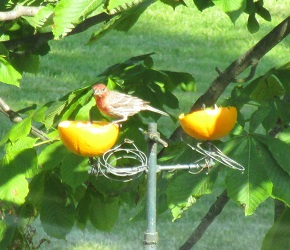
It happens around the same time every spring – a pair of purple finches, darting around the pillars of our wraparound porch, tufts of dried grass clutched in their little wedge-shaped beaks. They usually build their nest in the northwest corner, and we get to watch in delight as their fledglings transform from helpless, naked little T-Rexes into graceful ballerinas of the sky.
One year the birds were so successful they immediately reused the same nest to raise a second brood. Another year the nest blew down before they’d even laid their eggs. That time, the finches rebuilt elsewhere, seeming to have lost faith in their most trusted nesting spot. The following year they were back again, as if nothing bad had ever happened.
Which brings us to this year. 2020. This crazy, scary, nothing-will-ever-be-the-same-again year. The purple finches came right on schedule, just like always. Their presence was an achingly welcome sight. Here we were in the midst of a lockdown, a pandemic, facing uncertainty in almost every aspect of our human lives. And yet, for these birds, it was business as usual. For some reason, they built their nest in the northeast corner this time. For obvious reasons, we watched them more avidly than ever before.
The new nesting location quickly became a concern. There was an enormous pine tree right beside that corner of the porch that was literally tearing our house apart. It had to come down before any more damage was done, and the operation was going to be long and loud. We knew the finches already had eggs in the nest, and quite possibly newborn chicks. We dreaded what would happen on tree removal day. If the mother bird had to stay off the nest for too long, the brood would surely perish.
On the morning the pine was scheduled to come down, I woke up early, my stomach twisting like an anxious boa constrictor. All day long, I winced and cringed at every scream of the chainsaw, every testosterone-fueled bellow from the cutting crew, every ground-shaking thump as another section of the tree struck the earth. I kept looking at my phone, calculating how many hours they’d been at it – one, two, three, four. Every time I checked, my heart dipped a little more, as the chicks’ survival chances went down, down, down.
In the midst of the chaos, I peeked at the nest a few times, only to find it empty, of course. When the job was finally done, the crew left, their truck’s massive tires cracking over plywood placed on the lawn in the vain hope of protecting our grass. I held my breath, waiting for the mother bird to return. I let out a huge sigh when she landed back on the nest about fifteen minutes after their departure.
I immediately went inside to assure my mom, who’d been fretting over the nest just as much as I, that the bird had returned. Despite the good news, I also shared my fear that four-plus hours was simply too long for the female finch to have been off the nest.
“She wasn’t,” my mom said.
“What?” I asked.
“She wasn’t off the nest for that many hours. She came back in the middle and sat on those eggs. In the midst of all that sawing and yelling, that brave little bird came back.”
A huge grin broke across my face. I rose up on my toes and peered out over our lacy curtains at the tiny gray-brown bird dutifully seated on her nest. The commotion of the tree coming down had made me nervous, and I understood what was going on. I couldn’t imagine the courage it took for the mother finch to fly right into the epicenter of all that chaos and sit on her clutch when every instinct must’ve been screaming at her to flee. She might’ve been a dainty, delicate little lady, but she had the heart of a lion, for sure.

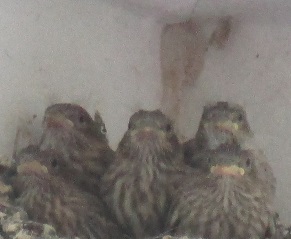
With the tree crisis in our rear-view mirror, our family went back to enjoying the peace and quiet as we watched the nest for signs of new life. A few days later, there was a dramatic uptick in activity, with the mother bird frequently flying off for brief periods. Whenever she was sitting on the nest, she constantly leaned down to tenderly nuzzle something underneath her. Though it would still be several days before those ugly, reptilian heads popped up, we knew our little avian friends had made their debut.
Momma Finch was a quick hunter-gatherer. She’d light off for a short bit, then return just as fast with a regurgitated snack for the brood. I loved watching her groom the chicks and nudge them gently with her beak before flying away once more. As the babies grew, so did her job – feeding them, keeping them warm, cleaning up after them.
“Does the father finch help her at all?” my dad asked one evening as we watched the mother deliver her last feeding of the night.
“Not really,” I replied. “He hardly ever shows up.”
My dad laughed and rolled his eyes. “That son of a gun!”
“He helps a little,” I amended, feeling the need to defend the guy.
In truth, I rarely saw the father bird, but the few times I did he was a sight to behold. Vivid red feathers splashed his head and chest, making his mate plain and dull by comparison. I have no idea how he spent most of the day, but the rare times he did arrive at the nest, it was quite the spectacle: excited screeching, frantic flapping. The chicks were obviously beside themselves, but it was their mom whose brown wings were beating so hard they blurred. It was she who screeched the loudest, turning into a chick herself as he fed her a little bit of regurgitated seeds or fruit.
Ah, I get it, I thought. She takes care of the chicks, he takes care of her.
Of course, she was fully capable of feeding herself, but what new mom doesn’t need a bit of pampering, a little “me time,” a small reminder that someone appreciates all of her sacrifices?
He did that for her, and she loved him to pieces for it.
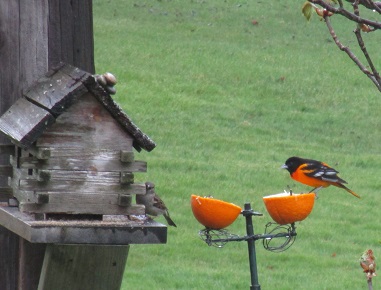
As the baby birds began to fledge, we looked forward to their first flight, and fretted over whether they might fall out of the next too soon…and land right in the waiting jaws of our porch cat, Joey, who’d taken to sleeping right under the nest.
As it turned out, though, the cat wasn’t what we needed to worry about.
I came in from my chores late one afternoon to find my mom standing anxiously at the window.
“What’s wrong?” I asked.
“Have you seen the mother bird lately?”
I frowned. “I saw her feeding them at around 11, but not since then. Why?”
“She’s been gone all afternoon,” Mom told me. “It’s not like her to leave them for so long.”
We spent the next few hours peering out the window, our anxiety spiking each time we saw a hungry little head waving above the nest and no mother bird there to feed it. My mom started voicing her fears that something bad had happened to the female, that she was injured, or possibly worse.
I didn’t want to believe it, and kept looking outside even as dusk fell, still hoping for the mother bird’s triumphant return. One time as I stood on my toes, scanning for any sign of her, I noticed a small, motionless shape lying out on the highway. A bubble of dread blossomed in my heart as I slipped on my sandals to go investigate. The bubble grew as I approached the flattened form of what was obviously a bird that had been struck by a car. It was nearly dark then, and I had to get very close before I was sure.
It was the mother finch. She was dead.
I walked slowly back to the house and delivered the news.
“The fledglings will die,” my dad said sadly, gazing out at the nest.
“Can you take care of them?” my mom asked me desperately, knowing I’d raised baby birds in the past with some success.
I bit my lip. “I can try if I have to, but first let’s see if the father bird starts feeding them. They’ll be better off with him than me.”
As darkness continued to fall, I was practically glued to the window. Come on, Poppa Finch, I silently begged. They need you, now. They’re your babies too.
Just as I was about to turn away in defeat, a flash of vivid scarlet caught my eye. My heart skipped and I pressed my nose to the glass, not caring that I was making a greasy smudge. It was him. He had finally come.
I imagine he was quite shocked when he arrived at the nest that first night. Here he was, expecting to find an ecstatic wife flapping happily for her treat and instead he got a nest full of loud, hungry chicks with no momma bird in sight. Whatever was going through his head, instinct kicked in and he immediately began to feed the chicks.
“He’s here!” I exclaimed to my parents. “He’s feeding them!”
The relief in our house that night was sweeter than music. Of course, we all knew one feeding wasn’t going to cut it. This male finch was going to have to recognize that his mate was never coming back. He was going to have to step up in a way he never had before and take care of these chicks full time – feeding them all day, every day, and cleaning the nest, too.
The next week was an anxious one as we catalogued the male finch’s activities. He didn’t feed the chicks as often as his wife had, but he seemed to give them more food when he did come. Possibly he had a larger crop than she did. He was definitely more efficient, depositing regurgitated fruit and seeds in each wide screaming mouth with almost robotic precision. He made sure everyone got something, every time. No small feat, especially considering that the brood was an extra-large one. Normally, the finches had three or four chicks per clutch. This year, they’d had a whopping five.

The father finch didn’t sit on the chicks, or spend nearly as much time nuzzling them as his mate had, but that was okay. He gave them what they needed. He gave them life. And when the time came, he took them safely out into the world. They didn’t leave the nest all at once, as they had in previous years. It was staggered–first two, then another two, then finally the last little straggler. Maybe he had to split them up because he was a single parent, and flight training five birds at once was just too daunting. He did a good job, though. Much to our relief (and Joey’s disappointment) not a single one of them fell into feline clutches.
Now, they’re all out in the great big wild somewhere, maybe still with their father, or maybe already starting to form families of their own. Maybe one of them will be back next year with a mate, ready to start the cycle anew.
Already, their mother must have faded into the backs of their minds. They’ve probably forgotten what she looked like. They were so young when she died, it’ll be a miracle if they have any memory of her at all.
I hope they do, though. Probably not anything concrete, or solid, or tangible, but maybe just a feeling they get when they’re perched on a branch with summer breeze rustling through their feathers, and their eyes are just starting to close. A sensation of warm feathers blanketing them in protection, or the gentle phantom touch of a beak nuzzling them. Or maybe they’ll hear a call in the distance, and for one second it’ll take them back to that nest where everything started. Back to her.
However it happens I hope for just a moment before they fall asleep each night, some deep-down part of them remembers a love that braved chainsaws and falling logs and yelling men to keep her babies safe. A love that was greater than fear, stronger than instinct.
A mother’s love.
 as the HERO flies...