Battling Back the Beast: How to Tame Your Overlength Novel

HarryPBigSpider2


If you’re like me, you feel a naïve rush of hope every time you spot a new article about overlength novels. Then, by the end of the article, you feel crushing despair. Because the answer’s always the same: if you’re a first-time novelist, and your novel’s overlength, your chances of landing an agent or publisher are slim-to-none.

Sadly, it makes sense – extra-long books cost more to publish (extra paper, extra ink). They take up more horizontal space, meaning fewer copies can occupy the bookstore shelf, and they can also be intimidating to consumers because giant tomes are both more expensive and more daunting to read. For a publisher to take that kind of risk on an unproven author (J.K. Rowling and Stephen King can go ahead and relax) doesn’t make a whole lot of sense.

The arguments against overlength novels are all very logical. The problem is, if you’re like me, and your novel falls into this category, then you’re pretty much screwed, right? You’ve got a product that is most likely unmarketable to agents and publishers. Sure, you could self-publish, but that doesn’t solve every issue. The length will still be off-putting to readers, and you may have to spend (and therefore charge) more if you’re doing a print edition. Another solution might be to split the novel into two or more parts. This will only work if you’ve genuinely got two or more complete stories contained within your bulky mammoth of a book – which unfortunately isn’t the case for the majority of overlength novels (it wasn’t for mine).

The best option for most writers, even those who want to self-publish, is simply to cut your manuscript down to size. An “acceptable” length for a first-time novel is about 90,000 to 120,000 words, according to Writer’s Market. I’ve heard from other sources that even going above 100,000 words is a risk. For fantasy or science fiction novels, you have a little more breathing room, with the maximum acceptable length being around 150,000 words. (This is to allow for the world-building necessary in these types of books.)

So, if your book is over 200,000 words, and you’re not even at the climax yet, you’re probably feeling pretty darn hopeless right now, because that’s a LOT of material destined for the cutting room floor. I know that feeling of despair all too well, because I’ve been there. My novel’s first draft weighed in at almost 300,000 words. Shocking, I know. Hopefully, most people reading this will get to say, “Well, at least mine’s shorter than hers.” That may be small comfort, however, when reality sinks back in and you’re still looking at 50,000-100,000 words of cuts.

Thankfully, the saga of my overlength novel has a somewhat happy ending: the current draft is in the 150,000-word range, and it’s getting closer to “acceptable” length every day. To me, it’s nothing short of a miracle. A time-consuming, frustrating, and frequently heartbreaking miracle, but a miracle nonetheless.

So, to all of my fellow overlength novelists out there, I came here today to give you back your hope. I came here to tell you it CAN be done: your novel CAN be whittled down into something that would not make an agent physically cringe at the mere sight of your word count. And I came here, most importantly, to tell you HOW this can be accomplished.

The following are some strategies I used to cut more than 140,000 words from my first novel, shaping it into a sleeker, stronger and hopefully more marketable book:

LARGE-SCALE CUTS

Go chapter by chapter. Do a breakdown of the vital information each chapter contains (e.g. maybe Chapter Two introduces an important character, or advances the plot in some way). Identify chapters that don’t accomplish very much. Cut those chapters entirely, and find other places to fit in the few stray passages that were relevant to the overall story.

Go plotline by plotline. If your book’s upwards of 200,000 words, chances are you’ve got not just a main plot, but quite a few subplots and other threads woven in there (e.g. the SPEW storyline in Harry Potter and the Goblet of Fire). Choose which are the most important to the larger arc of the book. Cut out the rest. And remember to eliminate all traces and future mentions of scenes you’ve decided to delete. If you’re not careful, you’ll wind up having the main character referring back to some incident that’s no longer in the book. Cue reader confusion!

Learn to make hard choices. You will have to cut chapters you adore. You will have to eliminate characters you have grown to love, characters who feel like real people. You will have to bring the axe down on some of your most breathtaking descriptions, your funniest jokes, and the scene it took you two months to get perfect. Take a deep breath, wipe a tear from your eye, and DO IT. As Stephen King says, “Kill your darlings.”

SMALL-SCALE CUTS

Go paragraph by paragraph. Weed out anything that wanders, meanders or breaks the flow. Cut out any bits that go off on boring tangents that take the reader away from what the scene is trying to accomplish (e.g. backstory is cool, but if you suddenly zip back to a main character’s childhood for three paragraphs right when he’s in the middle of a conversation, the readers are going to lose their place in the conversation). Also be on the lookout for redundant sentences (e.g. “Greg had hoped to find Mandy somewhere in the building, but he was out of luck. He looked upstairs and downstairs and couldn’t find her anywhere.” I mean, do you really need both of those? They kinda say the same thing. Plus, the first sentence gives away exactly what’s going to be revealed in the second. One of these babies needs to go!)

Change passive to active. Zero in on any instances of passive voice and rearrange those parts into active voice (e.g. change “The tests were handed out by Julia” to “Julia handed out the tests”). This usually cuts a word or two, not to mention the fact that most publishers hate passive voice, so it’s like a “two birds, one stone” kind of deal. 🙂

Go line by line. Check for unnecessary words in each sentence. Like, maybe you have Billy tilting his head back to look up at the sky. Well, if Billy’s looking at the sky, do you really need to say that he’s tilting back his head or do you even really need the word “up?” The mere act of looking at the sky implies his head is tilted back and he’s looking in an upward direction. (Unless Billy’s in an alternate universe where up is down and down is up. Then some clarification would be warranted.)

Learn when to tell instead of show. I know, I know, one of the Golden Rules of Writing is “Show, DON’T Tell,” but you have to know how to apply that rule. A story that tells absolutely everything isn’t going to be very good. But neither is a story that shows absolutely everything. When I was writing my first draft, I took the “Show, Don’t Tell” Rule a bit too seriously, and wound up with long paragraphs describing my character unzipping his backpack, searching around inside it, pulling out his notebook, unzipping a different compartment on his backpack, searching around inside it, pulling out a pen, and then, FINALLY beginning to write in his notebook (after he’d rezipped all the compartments, of course). See what I mean? There are things you must show because they’re vital to plot, character development, etc. Backpack zipping and other mundane tasks like walking and normal breathing are not things that need to be shown in depth. Just do a quick “tell” for those types of things, and you’ll be better off.

MORE TIPS AND TRICKS

Don’t do it alone. Get as much help as you can from friends, relatives, writing group members, English teachers and anyone else you can convince to read your book. Emphasize to these helpers that you need to cut words, and you need their honest opinions about what’s boring, what’s unnecessary, and what just plain doesn’t work.

Set small, reachable goals. Baby steps will get you to the finish line. My initial goal was to cut 100,000 words from my manuscript. However, that was too overwhelming to face all at once, so I broke it down into smaller chunks. I wrote the number “100” on a piece of blank white paper. When I’d successfully cut 1,000 words, I crossed out the “100” and wrote “99.” I chugged steadily along, cutting 1,000 words at a time, and then rewarding myself by getting to cross out the current number and write a lower one. Finally, one amazingly joyful day, I got to write “0.”

Once I’d completed the massive 100,000-word cut, I set a new goal: 10,000 more. This time around, instead of measuring by the thousands, I decided to cut 100 words from every chapter. Since my novel has just shy of 100 chapters, 100 words from each would result in a 10,000 word cut. It worked!

Cut anything that’s not awesome. You want your whole book to rock, right? Well if there’s a paragraph that doesn’t “wow” you, why not just get rid of it? Do the same for chapters, dialogue, plotlines, etc. Make the entire novel sparkle by slicing away any parts that don’t shine quite brightly enough.

And finally:

Remember what you’re fighting for. Sure, you want to get published, and to have a marketable product that people will want to read. But honestly, deep down, that’s not the main reason you’re doing this. Try to remember, through all of the cuts and the long hours and the heartbreak, that what you’re really fighting for is a better book. The very best book you are capable of writing. A book you would be proud to send to an agent, hand to an editor, or simply put out into the world with your name on the cover in nice, bold print.

And however much of your novel you need to cut in order to achieve this, you will get there.

One word at a time.

HarryP Little Spider


New Interview, Plus Two GREAT Writing Resources

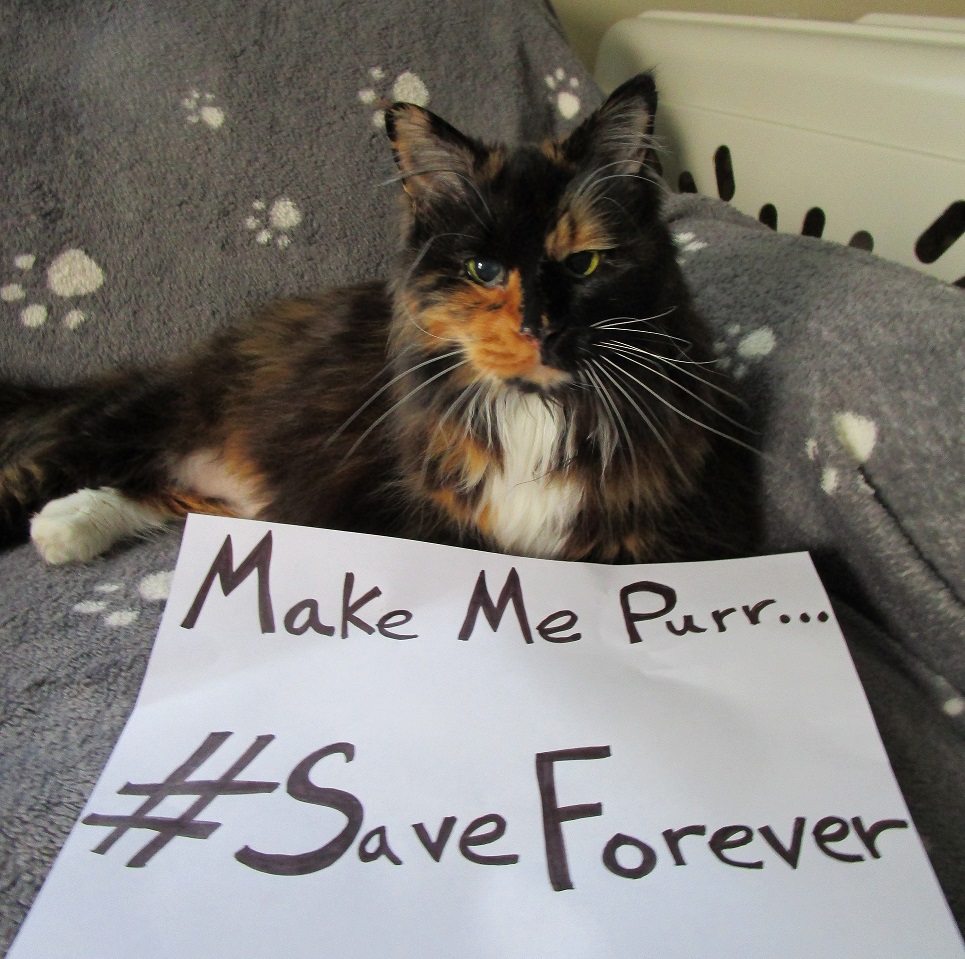
SaveForeverKitty

Many apologies for my recent absence, but I promise it was for a good cause. As my fellow Foreverists know, our beloved show was canceled following the wonderful Season 1 Finale. So, I have been busy trying to #SaveForever and help it get picked up by another venue. If you want to learn more about that effort and what you can do to help, this site usually has up-to-date info:

http://argylepiratewd.tumblr.com/saveforever

Be sure to check out the Facebook pages listed on that site for even more current info. Twitter is also a very happenin’ place when it comes to saving Forever, so look for trending events and other info on there, too.

And now, putting my fangirly stuff aside for a moment (yeah, like I ever really do that), here is my recent interview with Strange Musings Press:

http://giovannivalentino.blogspot.com/2015/04/author-interview-gretchen-bassier.html

We talked about the writing process, rejection, favorite authors, The Muppets, and in the end I went all fangirly (surprise, surprise) on Forever.

Since one of the questions in the interview pertained to writing resources, that sort of smacked me in the head and reminded me that I still haven’t mentioned two of my favorite sites for writers. An oversight that will be rectified right now!

For those just starting out or mired somewhere in the editing process, I cannot give strong enough recommendation for the site Superhero Nation. Don’t let the name fool you. Although Superhero Nation is geared toward helping authors write superhero novels, I have found that the bulk of their advice and articles apply to writing in general. And it’s darn good advice, too. So good that after reading one of their tips, I immediately rewrote a portion of my novel’s first chapter to incorporate their suggestion. As a bonus, this site is for fans, too, and features many reviews of superhero movies and other goodies. Go check out their numerous useful articles (including the awesome 10-part series “Common Mistakes of First-Time Novelists”)!

For those done with editing (does that ever really happen?) and ready to place their work, I highly recommend The Submission Grinder as one of many useful tools in finding the right market for your story/novel. Basically, The Submission Grinder is a free version of Duotrope. It has the same layout and everything. Right now they are only a database for fiction markets, but will soon be adding non-fiction and poetry. And the best part: The Submission Grinder has vowed to remain FREE for all users. I’ve had a lot of luck finding good markets on this site, so definitely worth a look.

Best of luck with your editing and market-hunting!

Up next on ATHF: Stay tuned for some major TV reviews, fic recs, and other fun stuff!

Hysterical Realms Release, Science Fiction Submissions, and Six Degrees of Jensen Ackles


Hystericalrealmscover
Alternate Hilarities 3: Hysterical Realms cover image designed by Aimee Maroney. Image used with publisher’s permission.

It’s finally here: Alternate Hilarities 3: Hysterical Realms was officially released yesterday, and, thanks to the awesome people who contributed to the Kickstarter, we raised enough funds for a print edition, so WOO HOO! Thank you so much to everyone who participated in that, and if you’re a reader who enjoys funny fantasy stories, definitely go check out the anthology:

Alternate Hilarities 3: Hysterical Realms

They also interviewed the authors for this book, so I’ll post a link to mine when it’s up.

In the meantime, Strange Musings Press has just opened up submissions for their newest anthology, Weirder Science. This time around, they want humorous science fiction stories. They are also having a contest to potentially rename the book, since they are not married to Weirder Science. Thus, everyone who submits a story can also suggest an alternate title, and the prize for the winner is pretty cool. So, go check that out, too:

Weirder Science Submission Info

And if you happen to be more of a “serious” science fiction person, there is another anthology currently accepting subs for their My Favorite Apocalypse collection. They are accepting short stories of any length (though they will likely regret that when they see how long my submission is) as well as poetry, but the deadline is coming up fast for that one: April 30th. Yeah, you’ve got just nine days, so better make it short:

My Favorite Apocalypse Submission Info

Don’t worry, you can make it if you really hustle! And, while I really should be getting back to my own apocalypse story, I just had to share a fun fact I discovered while browsing the Strange Musings Press website:

One of their previous books, Vampires Suck, contains a story by none other than Nicholas Knight – an author who is very well known to anyone who’s ever picked up an issue of Supernatural Magazine. He’s got a least one article in every issue, and has also written all of the Supernatural season companions. Before the fire, I never missed a single issue of Supernatural Magazine. I also own several of the season guides, and have always loved Knight’s articles and interviews. You can just tell he is a huge fan, and truly knows the show backwards and forwards.

He has also done probably hundreds of interviews with the cast and crew of the show. Which naturally got my fangirly heart making some pretty wild leaps. Because, after all, Nicholas Knight and I now share a publisher. Which means I am about a degree away from knowing him. And he knows Jensen Ackles and Jared Padalecki! He’s freaking met them and everything! Like, numerous times. So, by the way my delusional mind works, I am roughly two degrees away from knowing Jensen and Jared.

This is almost as cool as the time I shook hands with William B. Davis at the X-Files Expo back in ’98. The other actor giving autographs that day was Charles Nelson Reilly, who played Jose Chung on the show. Right when Davis was finishing shaking my hand, Reilly said something to him, so Davis looked over, and, in doing so, accidentally made a black dot on my hand with his marker. It was a Sharpie, too, so it didn’t wash off completely for several days. Oh, how I cherished that little dot…**happy sigh**

Wait. Hang on a second. William B. Davis was in Supernatural, too. He acted in a scene with Jensen in the Season One episode “Scarecrow” (one of the all-time scariest eps!). So [insert fangirly drumroll here] I shook hands with someone who, years later, acted onscreen with Jensen Ackles.

One degree, anybody? 🙂


Up next on ATHF: Race Results for February and March (will include my thoughts on the new CW show iZombie), plus my Strange Musings Press author interview


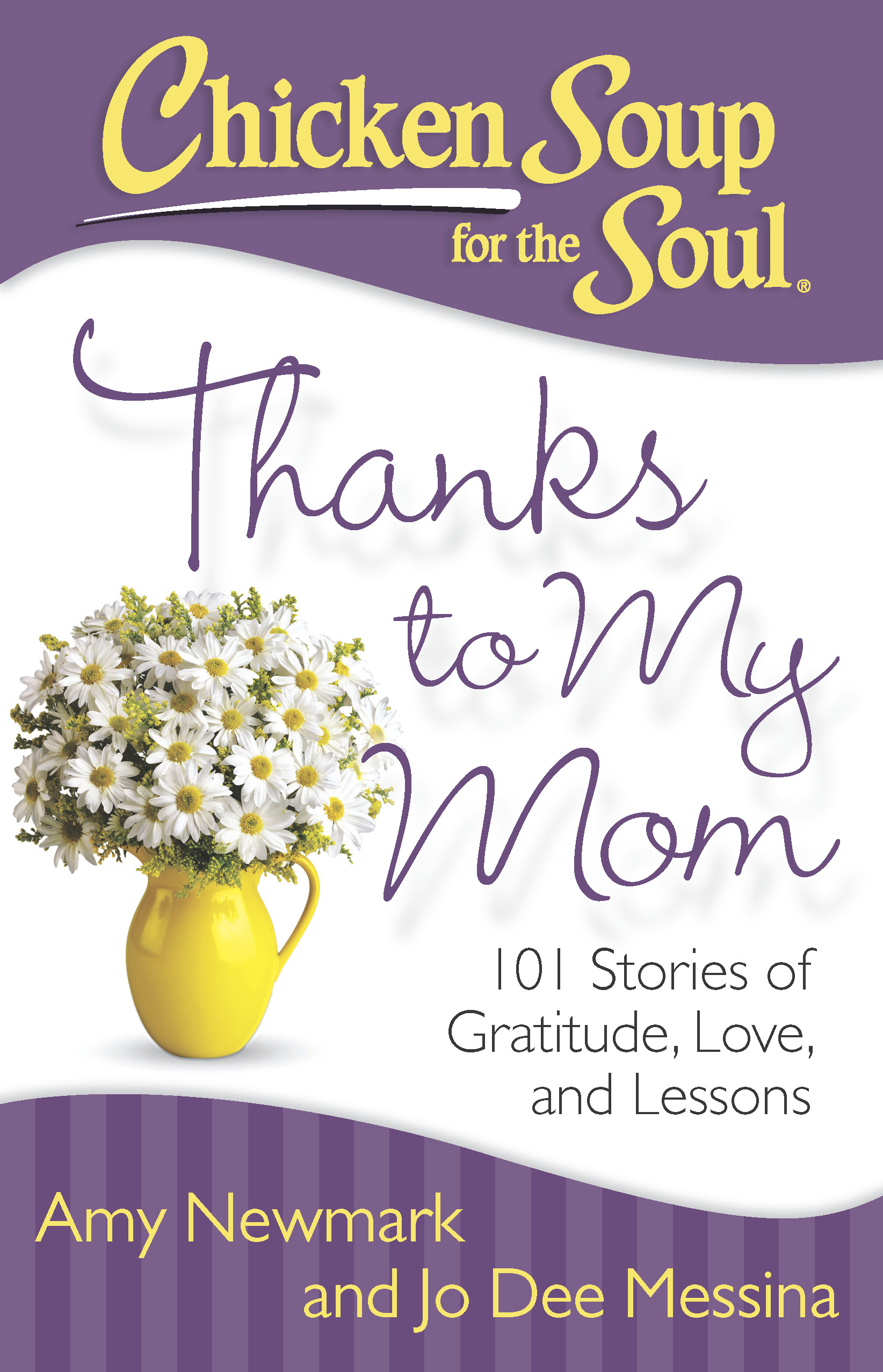
Chicken Soup for the Soul: Thanks to My Mom

Chicken Soup for the Soul: Thanks to My Mom cover design and layout by Brian Taylor, Pneuma Books, LLC. Image used with permission.

Tomorrow is a special day. Yes, I know it’s St. Patrick’s Day, but March 17, 2015 is special for another reason, too. Tomorrow is the day Chicken Soup for the Soul: Thanks to My Mom will officially hit the bookshelves. And my story “Honest Love” will be sitting there on page 302 for all to read!

For years, my mom has worked tirelessly at the tasks of being my editor, my sounding board, the person to whom I gloomily confess all of my rejections, and the person who has to read every single freaking draft of every single freaking story (even the ones that stink like last month’s dirty socks).

And what does she usually get for her efforts? I’ll give you a hint: it’s not a beautiful pitcher of flowers. Sadly, my poor mom has had to absorb the brunt of all my writerly mood swings, including the times I curl up on the couch and stare morosely at the wall. She’s endured me snapping at her and telling her that her ideas are not appreciated, because “it’s my story, and I like the way I originally had it.” She’s had the unfortunate job of breaking the news to me when a story just isn’t good enough for submission (because no one else would have had the guts).

She’s also been with me through the slow, painful realization that my stories, 99.9999% of the time, are not better the way I originally wrote them. That honest feedback isn’t something to be shunned or even just accepted grudgingly, but rather, it is to be horded like precious chips of gold, sifted from the dirt.

If my mom hadn’t given me tough love when I needed it, I wouldn’t be published today. If she hadn’t transformed my skin into leathery elephant hide, I would’ve quit submitting after that first rejection.

If you’re a writer, and you have someone in your life who not only reads all of your stories, but cares enough (and is brave enough) to give you helpful, honest feedback – even though it might earn them nasty looks and a week’s worth of undeserved silent treatment – then please, take a moment to say “thank you.”

I’m so glad I finally did.

-Gretchen


Hysterical Realms: Kickstarter and Submissions

Hystericalrealmscover
Alternate Hilarities 3: Hysterical Realms cover image designed by Aimee Maroney. Image used with publisher’s permission.

I posted about this anthology last year, remember? Well, guess what? My story “Seeing is Believing” made the cut! 🙂 The anthology is currently set for a May release…and there may still be time for your story to get in, too! They briefly reopened for submissions, so if you’ve got a short fantasy humor tale lying amongst the dust bunnies under your bed, pull it out, blow it off, and send it in! Even if you don’t have one lying around, maybe you could still whip one off in time. You have until March 10th. Speed-writing, anyone?

More info on submissions here:

http://www.strangemusingspress.com/p/alternate-hilarities.html

In the meantime, the Kickstarter campaign to fund a print edition of the anthology is in full swing right here:

https://www.kickstarter.com/projects/809941908/alternate-hilarities-hysterical-realms

Only 11 days to go on that – I really hope the funding comes through! I only just discovered Kickstarter a year or so ago, and what an amazing discovery it was. Though I’m a writer at heart, and always will be, I have secret hopes of someday being a publisher, too. There’s something so uplifting about the notion of helping other writers get published. When I didn’t have a credit to my name, Every Day Fiction took a chance on me and published my work. They made my dream come true, and wouldn’t it just be the most awesome thing if I could do that for someone else? If I could be the one who says “Yes!” after years of other publishers saying “No!”?

So, yeah, I’ve had some thoughts about becoming a publisher, even some very specific thoughts about publishing a magazine featuring writers from my home state. I even picked a title for this imaginary magazine. But I doubted it would ever happen, because how would I ever finance it?

Enter Kickstarter. When I saw what crowdfunding was all about, I knew that my dream of making other writers’ dreams come true might not be so far-fetched after all. If you’ve never looked at a Kickstarter campaign before, definitely go check it out. Kickstarter is a reward-based crowdfunding system, and the prizes for the Hysterical Realms campaign range from a free eBook and your name in the contributors section to signed hard copies of all three of Strange Musings Press’ anthologies, plus a character in the new anthology NAMED AFTER YOU. How freaking cool is that?

So, yeah, go check it out. And don’t forget to submit your fantasy humor shorts by March 10!

Flash Fiction Chronicles’ Annual String-of-10 Flash Fiction Contest is BACK!

My absolute FAVORITE writing contest of the year is back again, and it’s only open for one week – starting today. The reason it’s my favorite – it’s the most creatively-challenging contest I’ve ever run across. Also, it’s free. Also, I never do well in this contest, which you would think would make me want to quit, but instead it inspires me to work even harder every time.

The gist of the contest: They give you ten prompt words. Your goal is to incorporate at least FOUR of the ten into a 250-word (or less) work of fiction. They also give you a quote for thematic inspiration, although I believe use of the theme is optional. They have cash prizes for 1st, 2nd, and 3rd place, as well as a special prize for best use of the theme. All of the prize winners get published and also interviewed. As a bonus, the winners also get free books!

Possibly helpful advice: Think of ALL the different ways you might use each word, not just the most obvious way (e.g. “grave” can be where someone is buried, but it can also be used to describe a dire situation or a serious facial expression). Don’t necessarily go with your first story idea. And definitely read the past winners so you can get the flavor of what type of writing this contest favors.

This year’s prompt words:

SCRAGGLY – PECAN – ROUTE – SUCCINCT – ACCUMULATE – HANDLE – BIAS – EXIST – COAST – HANDKERCHIEF

Read the official rules and the inspirational quote here: http://www.everydayfiction.com/flashfictionblog/string-of-10-seven-flash-fiction-contest-begins-now/

Can you feel the ideas hatching already? Well, what are you waiting for – get cracking! These things are due on the 15th, people!

Best of luck!

-Gretchen

Ten Things You Should Never Say to a Writer

A friend and fellow writer found this painful-yet-all-too-true list on Pinterest. The proper title is “10 Things People Say to Creative Writers (but shouldn’t)” by Graphospasm. Having personally been a victim of Item #6 (“Have you been published yet?”) this list struck an ouchy chord with me, reminding me that a lot of people who aren’t writers don’t “get it.” In many cases, they don’t know what will hurt our feelings, what will make us bristle, and what is just plain RUDE.

I have no doubt the person who asked me whether I’d been published wasn’t trying to make me feel bad. Yet, he did. I was not published at that time, and I can still remember the feeling of my face turning red as I tried to stammer my defense: “Well, to get published, you really have to submit aggressively. Like, a lot of stories, to a lot of different publishers, and so far I haven’t really done that…” He was not impressed. Cue horrible feelings of failure.

Looking back, I feel bad that I felt bad. There was no reason for me to. I should have recognized that this individual simply didn’t understand the truth about writing (or publishing, for that matter), and made an uneducated remark.

The truth is, it’s HARD to get published. 85-90% of it is LUCK – the right story hitting the right market at the exact right time. Not being published isn’t a sign of failure, and it’s certainly no indication that your work isn’t good. What’s more, some writers don’t even WANT to get published. It’s not even on the agenda for them. One of my best friends has been writing short stories since grade school, and, to my knowledge, he has never once submitted one for publication. His joy comes from the writing itself. From having created something. From sharing that creation with his friends. From watching our “EWWWW!” faces and hearing our belly laughs as we read.

I wish I’d read this list a long time ago, before that encounter left me beet-faced and stammering. And, more importantly, I wish I’d read Graphospasm’s wonderful, pithy responses and more serious-toned explanations for each item. Just like getting your flu shot, you can inoculate yourself against rude (or well-meaning-but-ignorant) people by being prepared for the comments you might receive when you tell folks you’re a writer – and even having some funny answers ready!

So go check out this cringe-worthy list – plus the awesome responses the author and commenters came up with:

http://graphospasm.deviantart.com/art/10-Things-People-Say-to-Writers-but-shouldn-t-307241669

Hold your head high, be proud of your craft, and have fun building up your immunity!

-Gretchen


Book Signing to Benefit Furget Us Not Rescue

I am very excited to announce that I’ll be doing a book signing to benefit Furget Us Not Rescue, which is a 501(c)3 non-profit animal rescue here in Michigan. I will be signing copies of Chicken Soup for the Soul: The Dog Did What? and Chicken Soup for the Soul: The Cat Did What? from 12pm to 4pm on Sunday, December 21st at the Petsmart in Chesterfield, MI (Address: 51347 Gratiot Ave). All proceeds from the book sale will benefit the rescue group.

This is also a pet adoption event, so Furget Us Not Rescue will have their beautiful cats and dogs there for people to meet and fall in love with. Furget Us Not Rescue is always in need of both foster families and adoptive families for their many deserving animals (visit their Facebook page for lots of cute pictures!).

This will be a fun event for animal lovers of all ages, with candy, bookmarks, free gift-wrapping services, and lots of cute and cuddly pets to adore. We’ll also have photos of the pets featured in my two stories, plus an exclusive video of my cat Panic, who was the world’s one and only stick-hunting cat. This video has never been posted anywhere online, so this is the only chance you’ll have to see him doing his amazing and hilarious trick!

So, if you happen to live in Michigan, or even if you’re just in town for the holidays, stop by the Chesterfield Petsmart on Sunday, December 21st from 12-4pm. I would love to chat with you in person about writer stuff, fan stuff, and everything in between! While you’re there, you can support a great cause and maybe, just maybe, find the greatest holiday gift of all – a new, furry family member to love!

Hope to see you there!

-Gretchen


New Story: “Nude Kilometer a Modest Success”

In the mood for a chuckle? Go check out my story “Nude Kilometer a Modest Success,” which was just published in Untied Shoelaces of the Mind, Issue #10. It’s super short, free to read, and guaranteed to make you think twice about approaching a Canadian goose. Also, while you’re there, please take the opportunity to read the other stories featured in the issue – there’s something for everyone: horror, literary, romance, you name it!

Links:

“Nude Kilometer a Modest Success” – regular view

“Nude Kilometer a Modest Success” – printer-friendly view

Hope you enjoy the story – it was one of the first short stories I ever wrote, and definitely holds a special place in my heart :).


A Dream Come True…Times Three

blogdreampic


It all started with a simple dream: to complete my first novel. It took about three years – plus another two to type up the handwritten manuscript – but I did it. By the time I was finished transcribing, my heart was crowded with more dreams: write some short stories, get published digitally, get published in print, learn to write a screenplay, pen a piece of fanfiction (and have the guts to actually post it). One by one, all of these dreams came true…save #3.

I love getting published in e-zines for many reasons: your story is free for anyone to read, you can link to it on your website, and it’s just a great thing to have a sample of your work in such an easily accessible format – not to mention the awesomeness of instant reader feedback! But I must admit there’s something magical about being published in print. Just seeing your story in the pages of a book, being able to hold it in your hands and run your fingertips over the words…I wanted that. I think a lot of writers do.

And, for one reason or another, the dream just kept drifting out of reach. My very first acceptance was for a print newspaper in the city where I attended college. I was thrilled. Then it didn’t happen. No explanation, never heard from the editor again. I spent long months feeling baffled and hurt, then eventually moved on.

My next acceptance – or, as I like to call it, my first real acceptance – came from Every Day Fiction. One of the many things that drew me to them was that they were a digital market, but they also put out an annual print anthology of their best stories. Sadly, they stopped doing this shortly after I started submitting to them. As far as I know, they’ve never restarted. I think it was just too expensive. Completely understandable, but once again, I had to put the dream on hold.

Then, just last year, I got the acceptance I’d been waiting for: one of my stories had been selected for a print children’s collection. Cloud Nine, here I come…right? Wrong. In December, I received an email from the publisher that they were no longer doing multi-author children’s collections and there was no guarantee they would ever publish my story.

I started to think I might be cursed. I started to think this particular dream would have to stay just that: a dream. I started to think maybe it was time to let it go.

Thankfully, I didn’t listen to those little whispering cockroaches of doubt. I kept submitting to print markets, and finally, it paid off. A few months ago, as I shared right here on ATHF, I received notification that my story “The Greatest Gift” would be published in Chicken Soup for the Soul: The Cat Did What?

But the awesomeness didn’t stop there. A few weeks after that, I got another email from Chicken Soup for the Soul: my dog story, “Legacy,” had been selected to appear in Chicken Soup for the Soul: The Dog Did What?

A few weeks after that, the unimaginable happened: my werewolf story, “Burn,” was accepted to appear in the August 2014 issue of Trysts of Fate, a dark paranormal romance magazine presented by Alban Lake Publishing. A print magazine.

After all those times the dream had slipped away, it seemed just too good to be true. When the hyper excitement wore off, I began to worry that maybe it was too good to be true. Both of these publishers were very reputable, but still, I’d been burned in the past – multiple times. I couldn’t truly let myself believe – not until I could hold the books in my hands. Like, for real.

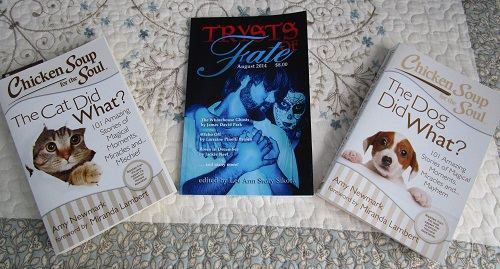
In mid-July, I got my wish: the first batch of contributor’s copies arrived, and I ran my fingers over the glossy cover of Chicken Soup for the Soul: The Dog Did What? for the very first time. I touched my name on the page, saw my words in print at long last. Less than a week later, I was holding a contributor’s copy of Chicken Soup for the Soul: The Cat Did What?, caressing the pages, smelling the crispness of fresh ink on paper. Then, about a month after that, my third baby arrived. Trysts of Fate was just as glossy as the other two, the striking cover art looking even better in person than it had on the publisher’s website. There was even something special about just knowing that they were advance copies – something most people weren’t able to read or touch just yet.

Nowadays, of course, anyone can hold my babies. Anyone can read them. The Chicken Soup books officially came out on August 19th, and can be purchased in bookstores and online. The August 2014 issue of Trysts of Fate is available in Alban Lake Publishing’s online store.

The dream has finally, officially come true. And in the process, two other dreams got fulfilled, as well: 1.) I got a non-fiction story published for the first time, and 2.) I got published in a book with one of my absolute favorite authors: Beth Cato. (Her wonderful stories “Welcome to the Navy” and “All About the Balloon” also appear in Chicken Soup for the Soul: The Cat Did What?)

So, now that I’ve had a month or so to bask in the glory, what’s next?

More dreams, of course! I have so many waiting in the wings: do a non-profit book signing, run a workshop with my writing group, finish my nano novel (yeah, still working on that…I think it’s become a trilogy at this point), have one of my stories illustrated, write a TV pilot, write a spec script for Castle, write a movie script, attend the Austin Film Festival, and of course the biggie – become a published novelist!

But that’s just me – what about you? What are your writing dreams, and how are you pursuing them? Maybe the only difference between a dream and a goal is doing something to make it happen…or simply not giving up the hope that it actually could.

Whatever your dream is, don’t give up on it. Even when Fate seems to be telling you, in a firm and convincing voice, that things are simply not going to work out for you. Sometimes there’s a nice surprise – or three – waiting just around the corner. 🙂

Keep writing!

-Gretchen