Another new year is almost upon us, and I’m feeling…introspective. There’s a lot I want to accomplish next year: Things related to writing, publishing, marketing. Things about healthy eating, exercise, weight loss. Stuff about trying to earn money, save money, and just be more financially responsible.
It’s all important stuff, and I really want to do it. But I think what I want most is just to be patient. To not feel like I’m rushing through everything. To enjoy little moments as they happen. To appreciate the gifts I have, and I have so very many.
I want to look at that sunset and stop what I’m doing and just stare at it for a moment and think, Wow. I want to suck in a deep breath of winter air and taste the woodsmoke, feel the snowflakes melting in my throat. I want to laugh when my cat licks my toes. I want to be happy when things go right, rather than worry about all the future stuff that might go wrong. I want to be a good friend, a good daughter, a good coworker.
I saw someone driving like a maniac today, cutting people off, getting honked at, the whole shebang, and I felt a twinge of pity. I wished that person could feel some peace. Slow down a little. I’m pretty sure the Kroger will still be there in thirty seconds.
We can all be a little better, drive a little slower, reach for the quiet joy in those tiniest of moments without letting life pass us by in a 75mph blur of smartphones and streaming and death-defying morning commutes.
Just outside that window, the sun is rising, and it is BEAUTIFUL.
If you ask kids what their favorite holiday is, most of them will probably say, “Christmas!” because they get presents. Some might say, “Halloween!” because they get candy. Growing up, October 31st was always my favorite day of the year, but it had nothing to do with receiving cavity-inducing treats. I loved Halloween because for one special night, I could be absolutely anything I wanted.
Trick-or-treating was fun, of course, and no kid’s going to refuse candy, but wearing that costume, putting myself in the role of someone not me–that’s what held all the magic.
On Halloween, I could be a flapper from the 1920s, the Bride of Frankenstein, or a vampire bat (my wings were so cool–they had glow-in-the-dark lines on them).
Halloween made me feel confident, playful, and powerful–all things I don’t particularly feel the other 364 days a year. It gave me the chance to walk in another man/woman/creature’s shoes, then take them off at the end of the night when they started to hurt.
I was a dragon, roaring around with green duct tape on my tail to protect it from dragging on the sidewalk. I was a bat, winging through the night, my cute clip-on bat earrings dangling from my woefully un-pierced ears. I was a Pooh Bear who sneezed messily, causing my dad to blow my nose on a dead leaf (not anyone’s finest moment, but you have to admire the ingenuity). I was the serial killer Red John from my favorite TV show, The Mentalist, sporting a ring of duct tape around my wrist and a small pocket knife I was too afraid to walk inside Meijer’s with because I might get in trouble. I was an artist, carving my masterpiece into the cold, slimy flesh of a pumpkin.
I was all those things and more, and I cherish every memory–except maybe the sneeze.
Today, I was a friendly werewolf, making patrons smile as they entered the library and laughed at my ears, paws, and tail.
Halloween hasn’t lost its magic yet, and I hope it never does.
Some thoughts leading up to the movie (click here to skip straight to the review):
Superman and I go way back. My first memories of the Man of Steel include lying on my belly on the yellow-gold living room carpet, watching the Christopher Reeve movies with my parents and older brothers. Our VHS copies of the films had been recorded from TV, which meant two things:
1.) They had been edited for running time and content. (I didn’t realize until years later that several scenes had been cut).
2.) They had commercials. My dad and brothers were pretty much experts at stopping/starting the recording to omit these, but one notable goof stands out, and the original Superman movies will forever be associated in my mind with a woman’s voice saying, “I don’t like your face” and the man’s reply of, “Shaving irritates it!”
The Christopher Reeve movies were good. I enjoyed them as much as a little girl could. Clark trying to keep his identity hidden from Lois in Superman II and having to battle a dark version of himself in Superman III were particularly memorable.
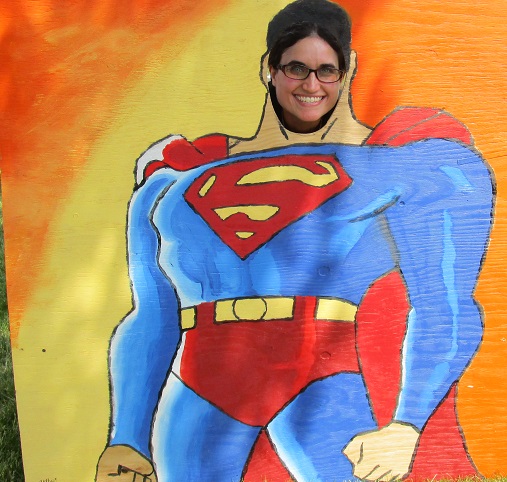
Me being Superman at an outdoor Comic Con (I should’ve taken off the glasses!)
I got a little older and Superman faded out of my life, until a new show came on called Lois & Clark: The New Adventures of Superman. Boy, was I hooked! Yes, the storylines were sometimes cheesy and the special effects were at times undeniably horrible. But the love story felt real.
In this version, rather than Clark Kent being a bumbling persona put on for show, Clark is actually the character’s real identity, and Superman is just his alter ego.
Clark Kent is who I am. Superman is what I can do.
This idea resonated with me, and I credit Lois & Clark for my deep love of Superman which still burns to this day.
When it came to Smallville, well I was still a little bitter about L&C getting cancelled, and questioned why we needed another Superman show so soon. Once I gave it a chance, I fell in love – hard – with this charming take on Clark Kent’s early years. Also, the special effects were pretty darn good.
Superman Returns was an unexpected pleasure. I know I’m in the minority, but I dug it. I liked the general storyline, and Brandon Routh’s portrayal of both Superman and Clark blew me away. He’s got this one line – I’ll take you back now, Lois – that’s so heavy with double meaning it makes me shiver. I was very much looking forward to the next installment of this, which we never got, because instead they gave us:
Man of Steel.
Which. I. Hated.
From Kryptonian creatures that looked like Avatar rejects to a young Clark just standing there pointlessly watching his dad die, this movie seemed to spit on everything I knew and loved about this fandom. I didn’t think it was possible for me to hate a Superman movie. This one proved me wrong.
I surprised myself by actually liking Batman versus Superman and Justice League. They were entertaining and they had Wonder Woman, so, all good.
Then along comes the TV show Superman and Lois.
Once again, I’m thinking, Do we really need ANOTHER Superman show? Once again, I’m proven wrong. Superman and Lois, I felt, was exceptionally well done (minus the last 5-10 minutes of the series finale – seriously, Do Not Watch, it’s horrible). But here we had an experienced, mature Superman battling to save the world while also raising two teen boys and attempting to be a good husband. It was the romance of L&C meets the teenaged-hero-coming-of-age-story of Smallville. Major props to Superman and Lois, and I’ll try to forgive the wretched ending, which apparently happened in part so there would not be two live-action versions of Superman in existence at the same time.
Because I guess they thought people might get confused between the TV version and the movie.
Which I wasn’t even sure I wanted to see. I mean, I’m 44 and there have already been three different Superman TV shows as well as seven(???) Superman movies in my lifetime alone. I mean, I love the guy, but seriously?
So, I waffled. Then I watched the trailer, and thought maybe. Heard some good things in interviews and decided to give it a go.
I spent part of the previews (pre-commercials, more like) explaining to my dad that it wasn’t going to be the same actors or storyline from Superman and Lois. I told him the show was cancelled.
Dad: Why?
Me: So they could make this movie.
Dad: ?????
Me: Yeah.
He then asked me how the show ended, and I had to go into all the depressing/annoying details.
Dad: Why did they end it like that?
Me: ?????
Finally, it was movie time.
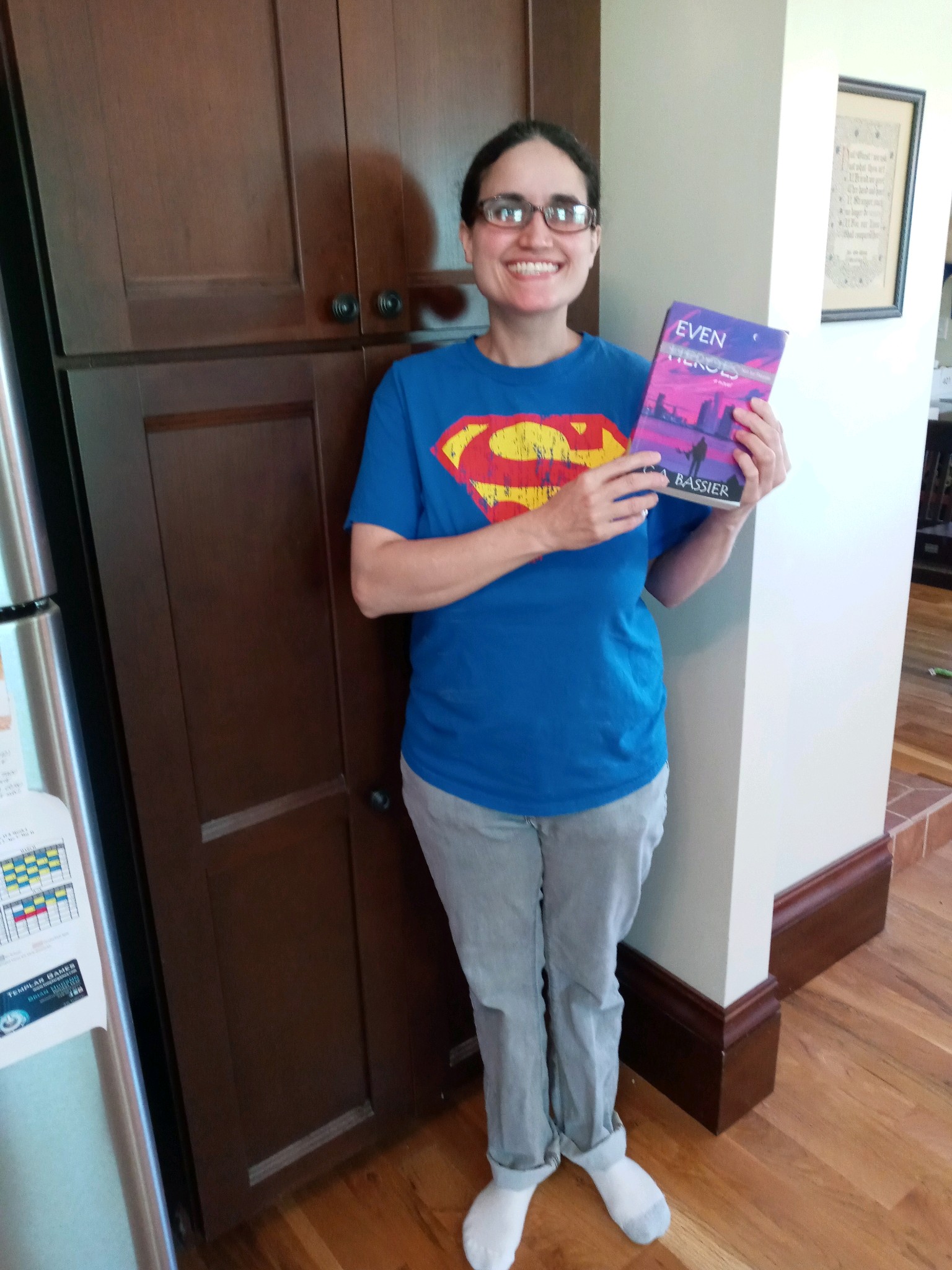
Me in my Superman shirt proudly holding an advanced copy of my superhero novel
Superman 2025 (this movie needs a better name) Review
Well, I knew going into it that a CGI dog in a cape was going to play a prominent role. So, I was aware the movie wasn’t going to have my preferred level of realism. Even so, as Krypto came running up in the opening scene, I still had to make a mental adjustment. It was like the first Avengers movie – I came to that having only seen Iron Man 1 and 2, which were fairly believable explorations of advanced technology. And then in Avengers there’s suddenly aliens talking about taking over Earth and I’m like, whoa, okay, I have to rapidly shift my expectations in order to enjoy this movie.
So, it was like that here, too. I had get in gear for things to be a little less realistic and a bit more absurd. Once I got in the right mind-frame, I could just sit back and enjoy the pleasant rollercoaster ride that was this movie.
Superman is more playful than your typical DC movie. It honestly felt more like a Marvel film. It has high energy, high stakes, lots of fun characters, and several one-liners that made me laugh. There are monkeys on computers, pocket universes, and a King Kong-sized creature that looks like Stitch from Lilo & Stitch.
It also has weirdly juxtaposed scenes at times, like Clark and Lois having a serious conversation while the Justice Gang (yes that’s their name, lol) battles a giant glowing monster in the sky outside the window.
This version of Superman’s character is a lot less restrained/reserved than what I’m used to seeing. At one point he is near hysterical when confronting Lex Luthor about Krypto’s whereabouts, and also gets pretty bent out of shape during a frustrating interview with Lois. I didn’t quite know what to make of this – Superman is usually about control and restraint. Because of how powerful he is, he can’t risk accidentally hurting someone, and he wouldn’t want to even appear to lose his temper in the public eye because it would erode people’s faith in him.
Granted, the public’s faith in him was pretty much in the toilet by the time he had the Krypto meltdown, but still. It bothered me. Then I read a review of the movie where the reviewer pointed out that this is Superman at the beginning of his career. He’s still figuring out how to act as Superman, how to interact with his fellow metahumans, how to do this whole hero thing. This isn’t Tyler Hoechlin’s older character with decades of experience under his belt. This is someone who’s fresh and naive and trying to do good but not always going about it in the most effective way or making the smartest choices.
That explanation worked for me, and helped me adjust my expectations for the character.
Lois and Clark had good chemistry, and for once Clark actually looked like a believably different person than Superman, sporting a wild mop of curls and glasses that supposedly had hypnotic powers capable of changing his appearance (good detail – makes the whole glasses-as-a-disguise thing seem more plausible). Jimmy Olsen, Eve Teschmacher, and Kara all made me laugh. The real scene-stealers, though, were Captain Hammer – er, Green Lantern – played by Nathan Fillion, Mister Terrific (he probably made me chuckle the most), and oddly enough, Krypto.
Yes, I can see why everyone loves the dang CGI dog. His behavior is SO awful it just takes you back to every encounter you’ve ever had with a terribly trained animal that you can’t help but love anyway. We’ve all had that dog, or know someone who does.
Lex Luthor is darkly determined to eliminate his nemesis, Superman. He has gone to extreme lengths to manipulate events in order to take out the Man of Steel. In the final confrontation, I really felt Lex’s raw hatred.
At one point in the film, a character gets murdered. This is the one part of the movie you really wouldn’t want younger audiences to see, and I don’t think it was necessary to the plot. The death is used as a catalyst to get one character motivated to take action. I think this could’ve been accomplished by something short of murder (torture, maybe?). It just felt like too much.
Overall, the plot worked, though towards the end I wasn’t entirely sure exactly what was happening, but I knew who I was rooting for and that was all that really mattered.
I liked that the movie touched on relevant topics, such as the risks/benefits/motivations for getting involved in foreign wars, the power of social media to shape public opinion, and the complicated tangle that is immigration. It felt fresh.
The ending is sweet and uplifting and kind of perfect, and will leave you glad you watched the movie. I saw one scene (also super-sweet) after the credits, but I’m hearing there’s a later one I missed. No worries – I’ll definitely watch the movie again (and probably own it). My dad turned to me after the movie and said he really liked it. I concurred.
The last and probably best thing I’ll say about it is this: I went looking for fanfiction afterwards, and found an excellent, still-in-progress story about this new version of Lois, Clark, and the gang. The author: someone who had never seen a previous version of Superman, but was inspired enough to write over a hundred thousand words about these characters and this universe. To me, that says more than positive reviews or ticket sales. Just like Lois & Clark did for me back in the 90s, this movie brought a new fan into the red-yellow-blue fold.
And I’m pretty sure they’ll be rooting for the Man of Steel for years to come.
What do you do when you’ve written a contemporary novel, but then it takes you 15 years before you’re ready to publish it? Do you update the manuscript for current events, technology, etc.? Leave it as-is, despite the fact that it’s now dated? Make everything as vague as possible and hope no one notices when exactly it’s supposed to be set?
This is the issue I faced with my first novel, Even Heroes. Although the initial draft was completed around 2007, the editing took place in spurts over more than a decade. All throughout the process, I flip-flopped between updating the time period and keeping it the way I originally had it.
At various points during revisions, my main character was listening to music on either a Walkman, a Discman, an mp3 player, or a smartphone. Social media platforms changed as they went in and out of style, seemingly with the direction of the wind. Current events were mentioned, taken out, then added back in again.
As I came close to a blessed final draft, the setting dilemma got settled once and for all, much to my relief.
Here’s where I landed:
The original 2004-2005 time period stayed put, however, many of the more dated references to technology were eliminated.
In the end, I hoped for something that would feel almost timeless, like a kid could pick the book up in 5-10 years and understand that it was set in the past, but not be stumbling over outdated references every five minutes.
I decided not to update the setting for several reasons.
1) Technology changes too fast! Even if I made all the references current at the time of publication, it would be outdated within a year or two anyway.
2) Political climate. Parts of my book take place in Detroit, which was going through a really hard era when I was writing the book. Some of the issues the citizens were struggling with back then fit with the story I needed to tell, so it made sense to stick with that very corrupt, dark period in the Big D’s history.
3) Social climate. This is just a purely personal opinion, but I feel like we, as a society, have fundamentally changed in the last 20 years. We are harder, we are meaner, and there is no longer any such thing as “sacred” or “off limits.”
Remember when The Sixth Sense came out back in 1999? There is a twist at the end of that movie, and there seemed to be a conscious effort by most viewers to preserve that secret for others, rather than spoil it. We wanted other people to have that same moment of surprise that we felt.
There was something magic about that–the unified effort to keep a secret, the basic consideration people were showing for their fellow man.
I think that magic is gone now. If The Sixth Sense came out today, people would be vying to be the first to spoil it for as many viewers as they could in the splashiest possible way.
In my book, the main character is a superhero. Despite his precautions, someone could manage to follow him home one night and blab his secret to the whole world. Back in 2004, in that kinder world where “good” secrets were still something precious, someone would be much less likely to do this.
There is one element of my book that I actually wish had become outdated, but sadly it hasn’t come to pass.
I began writing Even Heroes in 2004, a mere 5 years after the tragic events at Columbine High School. My book deals with a similar tragedy, aiming to look at bullying, school shootings, and youth in crisis through the lens of a superhero story–something I didn’t think had been done before.
At the time of writing, I could never have even imagined that school shootings and mass shootings would become so commonplace over the next two decades that many are not even deemed newsworthy.
Four months before my publication date, we had the worst school shooting in our state’s history.
As much as I want my book to be timeless, this is one way that I would absolutely love for it to become a relic of the past. I want kids in ten years to read it and wonder how such a thing could’ve been possible–a phenomenon so heinous, it’s shocking that it was ever allowed to happen.
If we ever get to that point with school shootings in America, where kids are reading about it in history books, rather than living it in the form of practice drills (or worse), I will gladly welcome in that new era.
In the meantime, if my book–even with its slightly dated references–provides hope for even one kid out there who’s struggling, then it has more than fulfilled its intended purpose.
I was on my way to work a few weeks ago, the traffic gods mercifully smiling down on me (they don’t always), when the driver in front of me suddenly swerved to avoid something in the middle of the road. In a few seconds, it was my turn to veer sideways as I came upon a beautiful tabby cat lying motionless across the center line. Dead. My heart cracked a little.
Then, right as I passed the animal, just as he was leaving my line of sight, came the slightest twitch at the tip of his tail.
It took my brain several seconds to process what I’d seen, and another one to slam on the brakes.
So there I was, stopped on the thankfully not very busy highway, the cat by this point looking distant in my rear-view mirror. I could see no further movement from the animal, and I wasn’t a hundred percent sure I’d seen it in the first place.
For an instant, indecision pulled me in two different directions:
Option One: Assume the cat was already dead. The slight tail-twitch I saw could’ve easily just been the wind ruffling the fur.
This notion held appeal for numerous reasons. It would mean the cat was no longer in pain. It would mean me being on time to work, and not having to make any difficult, complicated decisions.
And then there was Option Two:
Go check on the cat, see for sure if it was alive or dead, and then deal with the situation accordingly. If it had passed away, at least I could move the body off to the side of the road. But if it was alive, then things would get complicated. Messy. I would have to get involved.
All of these thoughts flashed through my brain in the span of a blink, maybe two. And then came the words, the ones that always come at times like these. The quote I’ve repeated in my head more than any other:
“Remember, if the time should come when you have to make a choice between what is right and what is easy, remember what happened to a boy who was good, and kind, and brave, because he strayed across the path of Lord Voldemort.” ~Albus Dumbledore, Harry Potter and the Goblet of Fire
I was already making my U-turn before the old wizard’s voice had even finished speaking.
I raced back to the cat and put my emergency blinkers on. The rest happened in an anxious blur:
The cat was still alive but in very bad shape. I pulled some gloves on and opened the back hatch of the car. Another driver stopped, also on his way to work, and I felt a rush of gratitude not to be completely alone in the situation anymore. I told him my plan to take the cat to the vet, and he thought I had the situation well in hand (I didn’t feel so sure, but I appreciated the vote of confidence).
I carefully wrapped the cat in an old jacket and laid him on a blanket in the back of the car, apologizing profusely for any further pain I was causing. I called in to work and left a message for the administrators, relaying what had happened. I probably talked a bit louder than necessary in my adrenaline-charged state but hopefully I didn’t yell.
Then we were pulling into a driveway to turn around, and zooming off to the nearest vet.
It took less than ten minutes. As soon as I arrived, I rushed around back to check on the cat. He didn’t look like he was still breathing, but the vet kindly let me bring him in just to double check. Sadly, he had passed on. I wasn’t surprised, but still felt a prickle of tears and a stab of grief for the person whose cat was not coming home that night, or ever again.
The vet promised to check the cat for a microchip and notify the owner if one was found. If not, they would take care of his remains with their stray cat cremation service. I left the jacket with him – a tangible sign that someone had cared for him at the very end – and slowly made my way back to the car and onward to work.
I was only fifteen minutes late – a small miracle, considering – and everyone was very kind and supportive about my decision to help the cat. Most of them probably thought I just naturally did the right thing, that I didn’t even consider doing anything else.
I wish I could say I’m that good of a person, but I’m not. The reason I love that quote from Dumbledore is because it helps me easily distill a hard decision down to its bare essence:
Is this the easy choice, or the right choice? It kinda sucks how often those two are not one and the same.
Sit by the TV with a beer and veg out after a long day at work, or drag yourself off the couch, inject some energy into your voice, and read the kids a bedtime story despite barely being able to keep your eyes open.
Throw your empty yogurt cup in the trash or rinse it out, crush it, and put it with the recycling.
Easy vs. Right. Whether a big decision or a tiny one, the advice works just as well.
Even with the choices laid bare, I still don’t always make the right one. The easy choice is often deliciously tempting because, well, it’s easy. And like I said, I’m not that good of a person. But with a little help from my favorite book series, I am trying to be a better one.
Hey all! Long time, no blog! My apologies for the extended absence. Some big life changes, including a sick cat and a brand new job, have kept me very busy and struggling to find my new “normal.”
I’m happy to report that the cat is doing better, and I’m starting to find small windows where I can squeeze in some writing time. Lately I’ve been writing on my phone when outside with one of my special needs cats, as well on my lunch breaks at work (that’s where I am right now!).
My new writing partner!
It reminds me a lot of the old days when I first started writing. I just couldn’t find a good time to sit down at the computer and write. And I realized if I waited until I could find time to do that, I’d be waiting forever. If I really wanted to write my book, I’d have to find another way – so I did. I handwrote my first book in 15 numbered notebooks while outside watching our dogs and doing other animal-related chores.
If you want something badly enough, you will find a way, and I guess I needed life to teach me that lesson again.
One thing I wanted really badly was to release my paranormal romance novelette, Scars, before starting my new job. I am thrilled to report that I got this done, and Scars is available on Amazon and can be read for free on Kindle Unlimited:
There you have it, folks! The cover art for Scars. 🙂 This one was pre-made and came from SelfPubBookCovers.com, courtesy of artist billwyc. Check out the rest of the artist’s gallery here:
I had a tough time choosing which cover to go with, but only because there were so many great options for werewolf stories and for romance. In the end, it came down to three finalists: a pretty picture of a wolf with roses around it, a gorgeous bit of art with a rose and a full moon, and the slashed chest. The image above won out because it most closely fit the title and the story itself. The main male character, Jack, actually has similar slashes on his body, albeit in a slightly different location. And it’s definitely not a “pretty” story. There’s some gore in this one, and some fairly graphic descriptions of violence. So, the ragged claw marks seemed appropriate.
As before, I had such a blast cover shopping. There is some amazing artwork out there. Kudos to the incredible artists whose images were the most delicious eye candy I’ve seen in a while. 🙂 Also as before, I did the lettering myself. I would prefer to have someone else do it, and maybe next time around I’ll be able to afford that, but for now I did the best I could. I did at least try to make it a bit more dynamic than I did with Even Heroes. That was one thing I was kicking myself over after the fact – just seeing the creativity of what others were doing with their lettering, I felt I probably could have done something a little less basic and bit more WOW.
In general, I am a lot less stressed about publishing this time around, mainly because I know what to expect from the process. And also, possibly because I’m doing more things right in round two, including getting my promotional options lined up ahead of my release, and getting some ARC reviewers on board.
Speaking of early reviews, check out this absolute gem I got from Asha over at Books and Readers:
Honestly, this is the type of review that would make any author’s heart soar, and I am so grateful to be on the receiving end of it! 🙂
Sooo, now that you’ve seen the cover and read Asha’s epic review, are you ready to read the story? If all goes well, my next post on here will be an announcement of publication. 🙂 In the meantime, if you’re an indie author, feel free to share a link to your own latest cover art in the comments. Did you buy a pre-made, commission an original, or create the cover yourself with your mad art skillz?
They say the definition of insanity is trying the same thing over and over again, expecting different results. Perhaps in spite of my better judgment, I am eagerly preparing for my second foray into self publishing! I learned SO much the first time around. I learned about buying cover art, and how to set up my title on KDP. I learned about keywords and categories and SEO. I learned how to codeanebook, for crying out loud! I learned how to find book bloggers who might (if I’m very lucky) be interested in reading and reviewing my book.
So yeah, I’m in a (slightly) better place this time around, and I’m feeling the excitement. And also the nerves. Because despite all the knowledge I gained last time, in some ways this is starting fresh. My first book, Even Heroes, was a full-length YA action/adventure novel that had never before seen the light of day. This one is a totally different genre: paranormal romance. It’s a short piece (considered either a novelette or a novella, depending on your definition), and it has been published before, in an anthology called Transformed.
I’m choosing to self pub this one for several reasons:
I love the story and the characters, and I want to share them with a (hopefully) wider audience.
Eventually, I want all of my work (past, present, and future) to be available in one place.
I have two more stories planned for these characters, so this will, in time, be a series. 🙂
The original anthology where the piece appeared seems to be out of print, so right now nobody’s getting to read one of the best stories I’ve ever written – that definitely needs to change!
In the coming week, I’ll be sharing more details, including the cover art reveal (oooh!) and a brilliant early review I’ve already gotten from an ARC reader. In the meantime, if you like angsty romance, nice guy heroes, and female werewolves who change into raging, homicidal beasts on the full moon, I’ll be offering advance review copies to interested readers via my newsletter, so be sure to sign up. 🙂
For all those who have self published a novel or are considering doing so, there’s one very important thing you should know: your book has a superpower. Sounds awesome, right? Until you realize what that superpower actually is: invisibility.
That’s right. Your book is invisible. No one can see it except you. So…not as awesome as what you were imagining (admit it – you thought your book could fly or shoot lasers from its title page). And let’s face it – invisibility is definitely not what any author wants for their precious newborn novel.
But that’s not the end of the story: YOU, the author, have a special power too. You are the only one on earth who can make your book visible to others. And that is an amazing power, if you can just figure out how to use it.
Below is a chronicle of my efforts thus far to make my debut novel appear in the eyes of the world.
After some initial sales to kindhearted friends and family members – and three wonderfully detailed reviews from book bloggers – my YA novel quickly returned to its original state of invisibility, where I sadly left it for several months. I didn’t really know what to do or how to move forward, so I just let it stagnate.
Eventually, I pulled myself together and made some kind of effort by enrolling the book in Kindle Select (This is what it’s called on the author side of things. On the reader side, it’s known as Kindle Unlimited.)
Enrollment has several perks. Readers with a KU subscription can read the book for free, and authors are paid a certain amount per page read (typically about half a cent). The program also allows authors to give their ebooks away for a certain number of days per enrollment period, or reduce the price for special, short-term sales called Kindle Countdown Deals.
The one main downside is that you can’t have your ebook available anywhere else – it must be an Amazon exclusive (not a dealbreaker for me, since my ebook wasn’t published elsewhere).
With much excitement, I arranged my first giveaway. I posted on this blog that my book would be free, and promoted it on Twitter (is anyone actually calling it X?) as well. All told, eight people downloaded the book during its free days. In my mind, that was pretty good – eight more people had discovered my book and might actually read it.
A few months later I tried another giveaway, this time promoting only on Twitter. Zero people downloaded the book. It was a definite low moment for me. Apparently, I couldn’t even give my book away. Then there was the fact that my one and only KU reader made it through 158 pages, then abandoned the book, never to pick it up again, and I would never know why.
After these glaring failures, I slumped into despair for a while, and my book sales were at zero for a good 5-6 months. Eventually, I picked myself up, dusted the self-pity particles off the butt of my jeans, and got back to work fighting for my book.
The first thing I did was spend weeks researching proper categories and keywords for my novel – something that should have been done prior to publication. I’ll try to do a separate post on this because it’s vitally important.
Bargain Booksy
Once my book was as well-categorized and keyworded as possible, I decided to try pairing a Kindle Countdown Deal with a paid promotion on Bargain Booksy. Bargain Booksy sends out emails to subscribers about discounted books ($4.99 or less) in each reader’s chosen categories. The discounted books are also listed on BB’s website.
In my case, I paid $25 for my book to be emailed out to the 150,000+ subscribers in their “Young Adult” category. My book was already priced low enough that I didn’t have to reduce it further, but I dropped it to $0.99 just to sweeten the deal.
My Bargain Booksy promo email went out on a Monday (the first day of my countdown deal). One person bought the book that day. I made another two sales the following day, and one later that week. Four sales, in all, and though I didn’t make back anywhere near what I spent, it still felt better having people buy my book than giving it away for free and having no one even take it.
Despite not selling oodles of copies, I will say that Bargain Booksy was very easy to work with, and gave clear instructions on how to set the timing of the Countdown Deal so that it would match up perfectly with the promotional email.
Also, I signed up for their newsletter (they strongly encourage all authors to do so) and while I enjoy getting the daily emails featuring bargain YA books, I do wonder how many of their subscribers are actually fellow authors who signed up in the process of advertising their books.
Amazon Ads
Having gotten a taste of people actually buying my book, I didn’t want to turn back. My next foray into paid advertising was through Amazon Ads. I found an awesome tutorial which simplified the process of setting up different kinds of ads, and got to work.
My first campaign was a sponsored product ad with automatic keyword targeting and a small amount of custom text. In this model, Amazon would choose my keywords for me, I would get impressions (views) if my bid was competitive enough against other advertisers, and I would only pay if someone clicked on my ad.
I set my bid at $0.40 per click, sat back, and waited. Not much happened. My impressions were at zero, and I got impatient, so I upped my bid by five cents every day until I started getting impressions.
I think my bid was at $0.65 or $0.70 by this point, and I was getting about ten impressions per day – very low, but at the time I had no idea ten was a bad number (FYI: if you get one click per 1,000 impressions, and one sale for every ten clicks, that’s pretty good). I left it alone for a month, got no clicks (and therefore paid nothing), but felt good that at least a few people were seeing my book. It was no longer invisible.
The next month, I tried a manual targeting campaign (i.e. I chose my own keywords). This was fun because I had researched the heck out of keywords several months prior, and since you can only choose seven for your book’s metadata, a lot of really good ones didn’t make the cut. This gave me a chance to use them all and then some.
I unwisely set my default bid at $0.60, allowing it to go up to $0.90 for prime advertising real estate (e.g. the top of the search results page). Right away my impressions were in the upper hundreds/low thousands, and I started getting clicks. Sometime during that month, one of those clicks resulted in a sale. I was ecstatic – someone had discovered my book, read the description, and decided the novel was worth spending money on.
The next few months ran in a similar vein, though the spend gradually increased from $15 a month, to $20, to $25. I typically sold between 1-3 books per month through ad clicks, and was definitely in the red, but still feeling good about investing in my novel.
Things went both right and badly wrong in January. About a third of the way through the month, my sales jumped to $111.92. I thought it was a mistake. It turned out not to be.
Apparently, I had sold eight paperbacks from a single $0.75 click. This was really cool, but also confusing. Why would someone buy eight? I felt like I was missing something, something bad, but couldn’t figure out what it was. Part of me wondered if Amazon periodically buys books from its own advertisers, then resells them, all the while keeping authors addicted to ads via the sweet taste of making the occasional sale. I doubt this is the case, but wouldn’t it be a massive scandal?
No matter what the reason for the weird eight-book click, my impressions soared, as did my clicks, yet I failed to make another sale that month, landing me deeper in the red than ever before. In the end, I spent over fifty dollars on ads in January, and only made ten of it back in royalties.
Being on a very tight budget, I couldn’t afford to continue at this rate, and after a panicky and disastrous effort to quickly lower my bids, I ended up having to pause both my campaigns (the manual, and the automatic, which I had left running because it occasionally came alive and generated a few clicks, though never any sales).
I am not done with Amazon Ads, but I do need to regroup and figure out how to do it on a budget that works for me (i.e. much lower default bids). I also need to view it as a long-term investment and let things grow and build momentum slowly, rather than jacking up the bids in the first few days just to see some results.
Voracious Readers Only
Even though I sold some books through paid advertising, I felt that I could have sold more if readers had more than 3 or 4 reviews to peruse for info and opinions about my novel. In an effort to gain reviews and new readership, I did a free twenty-book giveaway on a site called Voracious Readers Only. This site focuses on connecting readers with fledgling authors, in hopes of the experience being beneficial for both parties.
Authors gain new readers (who are encouraged by the site to leave reviews), and also get to add those readers’ email addresses to their mailing lists. Readers get a steady stream of free books and the chance to help authors out by joining their mailing lists and leaving reviews.
To get the most out of my giveaway, I decided to first set up a mailing list. I signed up for a free account on MailerLite.com. They quickly informed me that sending out my newsletter from a free email address (e.g. yahoo, gmail, etc) was very bad and likely to go to spam instead of my readers’ inboxes. They recommended that I purchase my own domain and a professional email address to go with it.
Thus, what started off as a free venture ended up costing me $$$$$. When all was said and done, I owned my own website, and had a pro email address. Later, I got to thinking and decided to check the sender addresses of the author newsletters I am subscribed to. They were ALL free emails. **facepalm**
On the bright side, since I upgraded my WordPress site, you won’t have to look at those gross adds for reducing belly fat anymore. So, you’re welcome. 🙂
My experience with VRO was…interesting. Unlike Bargain Booksy, I didn’t find VRO’s interface to be user friendly. I was confused several times while setting up my giveaway, had no idea what information was going out to readers, and began to wonder whether it was even okay to put anyone’s email on my list, should I be lucky enough to get any requests.
Also, when entering info about my book, there was apparently a word count limit in the “reviews” section…however, the site didn’t let me know that. I included the three reviews I’d gotten from book bloggers (VRO asked for 3-5 reviews), but one of my reviews got cut off in the middle and there was no way to see this until after the form was already sent. I thought my form looked like a pile of crap, and worried that this was what readers were going to see.
The day of my giveaway arrived, and requests began to trickle in before the one-hour window opened, and continued all the way until the next morning, until I accumulated the promised total of 20 opt-ins. Thankfully, the communication from VRO on that day was clearer, and I at least understood that everyone who opted in had voluntarily signed up for my mailing list.
Time to get to work! I dutifully sent out copies of my ebook to everyone who asked for one, thanked them profusely, and signed them up for my newsletter. The automated Welcome message I’d set up on MailerLite seemed to go out exactly as planned. Roughly half of the readers opened the newsletter, while the rest ignored it or it got lost in their spam traps. One person immediately unsubscribed, which didn’t feel great, but I tried not to take it personally.
Still, I had a few subscribers, and that felt good. Roughly a month later, a new review popped up on Amazon from one of the VRO readers. Just a single word – “Stunning” – accompanied by a five star rating. It was definitely one of the better days I’ve had in a while. 🙂
Takeaways
Investing in my novel feels so much better than giving up on it.
Paid advertising DOES sell books, but so far not enough to cover the cost of the ads.
Giving my book away in exchange for subscriber email addresses seems more beneficial than just giving it away for nothing.
In case you missed that big purple button up there, I have a newsletter now! Here’s where you can sign up: https://subscribepage.io/gabassier_newsletter (if you’re on the fence about clicking, there’s a REALLY cute pic of my cat Black Canary on there).
I can’t wait to save up a bit of $$ and try more adventures in advertising!
Are you an indie author trying to market your books? What have you tried so far? What works for you and what doesn’t?
Just to start off: I am a majorMonk-aholic. I’ve seen every episode at least twice, plus read most of the excellent tie-in novels by Lee Goldberg. So naturally, I was thrilled to see an advertisement on Peacock for a brand new Monk movie. I watched Mr. Monk’s Last Case on the day it released – December 8th – and I’ve been wanting, maybe needing, to talk about it ever since.
The first thing fans need to know is that this movie has an underlying tone of despair which was not typical of the original series. I noticed by chance in the upper corner of the screen that one of the warnings on the film was for suicide. I frowned, thinking this might be an unintentional spoiler for the case Monk would be investigating. Not so.
The reason for the warning quickly becomes clear in the movie’s early scenes. Mr. Monk is not doing well at all. In fact, he is deeply depressed and planning to end his own life.
When last we saw Adrian, he was euphoric from finally solving his wife’s murder, and happily building a relationship with his newly-discovered step-daughter, Molly. But more than a decade has passed between then and now, and times have definitely changed. Over the course of the movie, we learn it’s not one big thing causing Monk’s depression, but rather a series of events and feelings that have all chipped at him over time.
Most of his loved ones have scattered and moved away, including Natalie. Monk is no longer working as a police consultant, and the only people he regularly interacts with are Molly, Dr. Bell, and Trudy (in the form of ghostly visions). Monk’s social isolation is sharp and palpable.
The pandemic dealt his mental health another crippling blow, causing a resurgence of his agoraphobia as well as cranking up his OCD to unbearable levels. Although Monk lived to see the other side, he never truly recovered from the trauma of being that afraid for so long.
There’s been much talk about how we all came out of the pandemic psychologically worse for wear. Whether or not you got the virus, whether or not you personally knew someone who passed away, we all have scars. No one came out of those years unscathed.
But there hasn’t been as much discussion about how it affected the people who were already struggling with demons like depression, germaphobia, isolation, etc. before Covid, how much worse it was for them. By now, most of the world has moved on, but there is this forgotten group of people who physically survived, but never fully came back. In some ways, I am one of them.
I appreciated that the movie talked about this, and using Mr. Monk as an example was the perfect way to explore the issue – a beloved character who is already well-known for his mental health battles, so we’d easily be able to understand just how hard everything hit him.
Monk’s suicidal intent is the dark current running beneath the rest of the plot, which features many of the character returns and emotional moments fans will be expecting.
The regular gang reunites for this adventure, including Stottlemeyer, Natalie, Randy, and Dr. Bell, all portrayed by their original actors. Trudy’s spirit plays an important role here, just as she did in the series, and Sharona appears in a flashback, so she is included as well.
The only recast is Molly, originally played by Alona Tal (aka Jo on Supernatural). Not sure why they cast a different actress for the film – possibly they wanted someone with a more easy, free-spirited vibe? – but it shouldn’t bother people too much as Molly’s only appearance on the original series was for probably about 60 seconds in the last episode, and the new actress, Caitlin McGee, does a great job.
The movie hits all the right beats for a typical Monk story:
Randy presents an outlandish “theory” about the case, complete with an equally ridiculous visual aid.
The Randy Disher Project gets a hilarious shout-out.
Adrian plays his clarinet (incorrectly identified in the closed captioning as an oboe).
Stottlemeyer grumpily disagrees with Monk about the prime suspect.
Monk gets to say his classic, “He’s the guy.”
Natalie and Monk team up to investigate, resulting in numerous car crashes and lots of hysterical screaming (Monk being the screamer, of course).
The bad guy looks like he’s going to get away with it.
Monk gets that smile on his face when he finally solves the case, closely followed by, “Here’s what happened…”
Another highlight was the introduction of the new, cooler-than-cool police captain, Lisa Rudner, who obviously knows a valuable asset when she sees one. She makes it very clear she wants Monk to return as a consultant. Although Rudner isn’t in this first movie that much (yes, despite the movie’s “last case” title, I would be surprised if they didn’t make another one), her brief scenes show that she cares more about getting justice for victims than about politics or appearances – a sharp contrast to Captain Stottlemeyer in his early days, when he hated having Monk called in on a case because it might make the captain and his officers look incompetent.
Overall, the mystery is not the most complex or well-written one in the history of the series, and there are a few plot holes I won’t get into here to avoid being spoilery, but emotion is the true engine of this story, and the movie has that in spades. From the devastatingly personal nature of the case to Monk’s private battle with depression, there is more than enough substance here to elevate the storyline to the status of a movie as opposed to just a super-sized episode.
Despite the many wonderful comedic moments, the sadness is what stayed with me most, so much so that when I walked in on my mom watching an old Monk episode the other day, my heart twisted at the knowledge of what is to come for this character, what he will have to endure before finally coming back into the light again.
And, yes, Mr. Monk does survive the movie. But not because one of his friends runs up at the last moment to knock the pills out of his hand. Despite Monk’s cryptic comments throughout the movie, and the concerned looks he gets from Natalie, Molly, and even Stottlemeyer, no one seems to know exactly how close he is to ending it all, and that’s scary.
Monk’s psychiatrist has a better idea of what’s going on than anyone else, and there’s an extremely touching scene that brings them both to tears (me too). But no matter how many people tell Monk he is loved and needed, it just doesn’t seem to sink in.
And as desperately as I wanted someone to get through to him, to shake him and yell at him and tie him down until he finally listened, in the end the decision to live comes from within Monk himself. I think it has to. The way it happens is sweet and special and I won’t spoil it, but it is worth seeing – just like the movie itself.
Honestly, I don’t know if it will hit most people as hard as it did me. It’s all about what you’ve been through, and what you’re going through right now. I’ve known three people who’ve taken their own lives, so this movie dredged up a lot of that old pain. For viewers without that personal history, it might just be like a regular Monk episode. For others, it might be too hard to even watch. Graphic images of Monk hoarding and counting out prescription sleeping pills, opening a high-rise window as if to jump out, writing goodbye letters to all of his loved ones – these could be triggers for people who are already on the brink.
In the end, I think it was an important movie exploring the after-effects of the pandemic on those who were already in crisis. It made me want to listen to “Hate Me” by Blue October. It made me want to check up on the people in my life. It made me want to check up on myself.
If you’re reading this, and you’re feeling some dark thoughts, I hope this movie inspires you to reach out for help. Or reach inward, as Monk does, and see the value you bring to this big, scary, wonderful world and the people in it. A value onlyyou can bring.
We’re never as alone as we think we are, and neither is Mr. Monk. (Keep watching past the credits, and you’ll see what I mean.)
Stay safe, take care of each other, and have a Happy New Year.









 as the HERO flies...